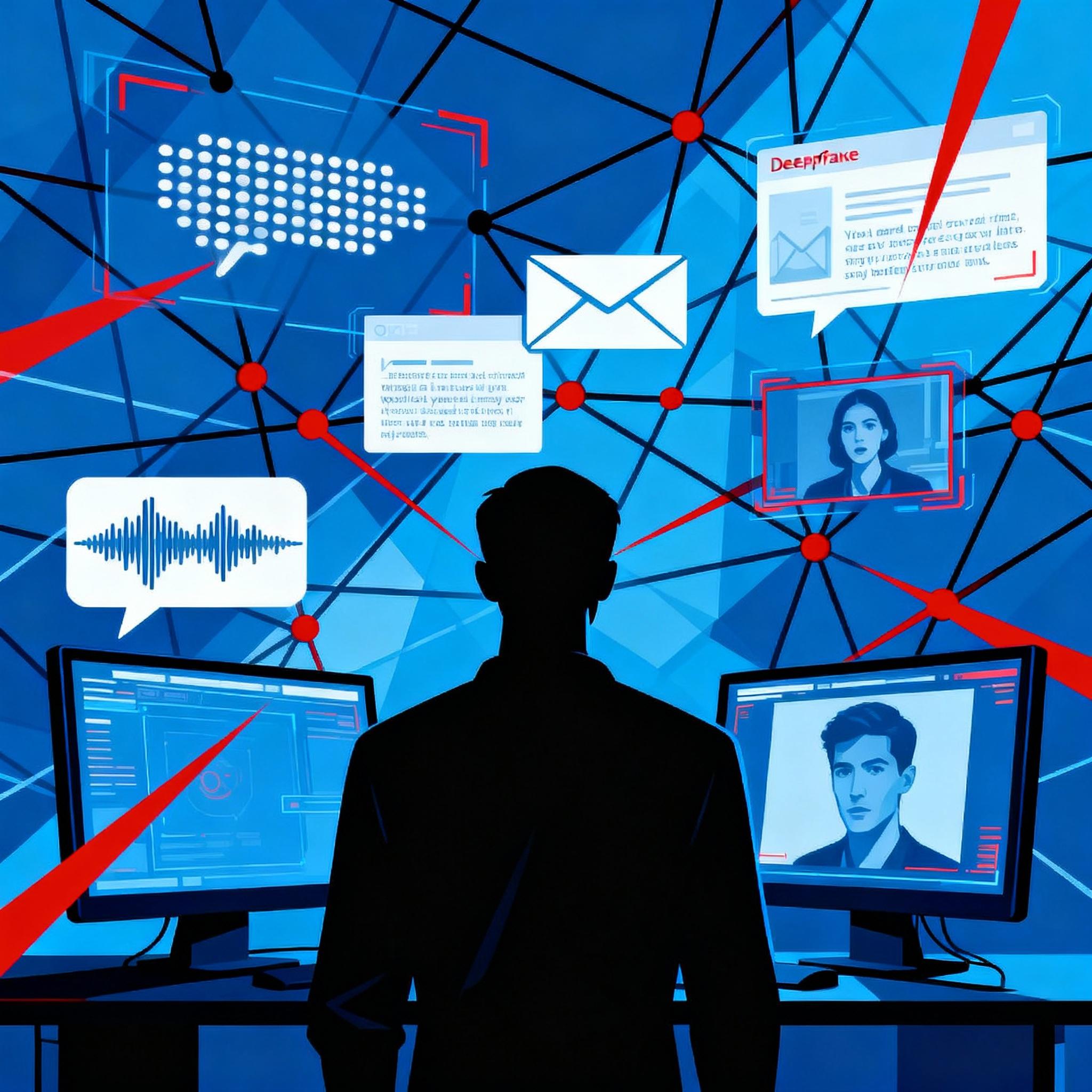
AI-Generated Social Engineering: A Practical Framework for Defending Against LLM-Supported Phishing, Voice Cloning, and Deepfake Impersonation in 2025
Hands-on framework for detecting and mitigating LLM-powered phishing, voice cloning, and deepfake impersonation — practical controls, telemetry, and playbooks.
AI-Generated Social Engineering: A Practical Framework for Defending Against LLM-Supported Phishing, Voice Cloning, and Deepfake Impersonation in 2025
The arrival of high-quality large language models (LLMs), accessible voice cloning tools, and inexpensive deepfake video generators has fundamentally changed social engineering. Attacks are faster to craft, harder to distinguish by eye or ear, and more personalized than ever. This post gives engineers and security teams a practical, implementation-focused framework for detecting, preventing, and responding to LLM-supported phishing, voice cloning, and deepfake impersonation in 2025.
What changed in 2025: the threat landscape
- Scale: Attackers can generate hundreds of tailored messages per hour and A/B test subject lines, tone, and pretext with automated feedback.
- Fidelity: Synthetic voice and video are realistic enough to pass casual human vetting; small context-aware edits make social-engineered narratives convincing.
- Automation: End-to-end pipelines combine OSINT enrichment, LLM prompt chains, and voice/video generation to produce personalized lures.
These factors compress the detection window and raise the bar for traditional training-only defenses.
Failure modes of traditional controls
Traditional controls break down against AI-augmented attacks for a few reasons:
- Signature-based email filters rely on known patterns; LLMs generate polymorphic messages that evade simple rules.
- Per-user training is necessary but insufficient — humans still comply under believable pretexts, especially on mobile and voice channels.
- Simple authentication (sender display name checks) fails when attackers spoof or compromise legitimate infrastructure.
A practical defense mixes improved detection telemetry, preventative hardening, and measurable response playbooks.
A practical, layered framework
The framework below is goal-oriented, prioritized for engineering teams that need concrete controls.
- Detection: automated signals for LLM-style artifacts.
- Hardening: reduce impersonation surface and improve provenance.
- Training + verification: focused, scenario-driven drills and out-of-band checks.
- Response & forensics: playbooks for containment, attribution, and recovery.
Each layer should feed telemetry into a central SIEM / EDR / SOAR pipeline so detections can be tuned and playbooks can be automated.
Detection: signals you can extract today
Capture and score multiple orthogonal signals. Relying on any single indicator will fail.
- Linguistic fingerprints: compute embedding distance between incoming message and known-sender baseline. LLM-injected messages often diverge in syntactic micro-patterns.
- Semantic oddities: chain-of-thought hallucinations, contradictory details, or contextual inconsistencies (time zone, tone mismatch) are red flags.
- Metadata anomalies: SPF/DKIM/DMARC fail, return-path mismatch, bizarre mail-routing headers, or first-time domains.
- Targeting & timing: distribution to unusual recipients, unusual forwarding patterns, or urgent call-to-action outside normal workflows.
- Voice/video artifacts: spectral inconsistencies, lack of breath micro-movements, frame-level interpolation artifacts, or missing cryptographic watermark.
Combine these signals into a score and insert a human review step when the score crosses a threshold.
Example detection scoring pipeline (conceptual)
Below is a minimal pipeline in pseudocode you can implement and iterate on. It combines embedding similarity, header checks, and contextual heuristics.
# compute embedding similarity between incoming message and sender's historical corpus
def compute_embedding_similarity(message_embedding, sender_embeddings):
    # return cosine distance into 0..1 where 0 is identical
    return min(cosine_distance(message_embedding, e) for e in sender_embeddings)

def header_anomalies(headers):
    score = 0
    if not headers.get('DKIM-valid'):
        score += 0.4
    if headers.get('Received-path-unusual'):
        score += 0.3
    if headers.get('domain-age') < 30:
        score += 0.2
    return score

def contextual_checks(message):
    score = 0
    if message.includes('urgent') and message.is_out_of_band():
        score += 0.25
    if message.requests_funds_or_credentials():
        score += 0.3
    return score

def score_message(message, sender_state):
    emb_dist = compute_embedding_similarity(message.embedding, sender_state.embeddings)
    total = 0.5 * (emb_dist) + 0.3 * header_anomalies(message.headers) + 0.2 * contextual_checks(message)
    return total
This pipeline is intentionally simple — implement it, collect false positives, and iterate thresholds with real telemetry.
Hardening: reduce the attack surface
- Enforce strong email standards: strict DMARC with quarantine/reject, MTA-STS, and DNSSEC where possible.
- Use short-lived API keys and mutual TLS for internal services and automation; reduce reliance on email-based approvals for sensitive actions.
- Introduce cryptographic attestation: sign high-risk voice/video sessions with session-level attestations (challenge-response tokens) and verify them server-side.
- Device attestation: require FIDO2 or enterprise device certificates for privileged operations and for initiating financial or admin workflows.
The goal is to make impersonation materially harder and to provide verifiable provenance when attackers attempt it.
Training: focused, measurable, scenario-driven
Replace broad “phishing awareness” slides with scenario-based drills:
- Red-team the entire pipeline (email → phone → video) using synthetic content to measure detection and human response.
- Teach verification workflows: when an executive requests a wire transfer, do a voice or token-based out-of-band check using a pre-registered control channel.
- Metrics: track response time to suspected impersonation, fraction of high-risk interactions verified out-of-band, and false positive rates for your detectors.
Response & forensics: playbooks for AI-enabled attacks
- Immediate containment: block sender domain, take down related content, suspend compromised accounts, and freeze suspicious transfers.
- Evidence collection: preserve raw message bodies, full header traces, voice/video files, and timestamps. These are crucial for later model-based attribution.
- Model-assisted enrichment: use LLMs to summarize large corpora of messages, but verify LLM output before trusting it in legal or technical reports.
- Attribution: cross-check artifacts (e.g., metadata in generated video) against OSINT and industry takedown partners — deepfakes often leave tool-specific fingerprints.
Monitoring & telemetry you should instrument
- Per-user historical embeddings (email style, phrasing) with rolling windows for drift detection.
- Voiceprint templates for known spokespeople (stored securely and used only for verification signals, not raw audio).
- Message provenance dashboards: DMARC pass/fail, earliest Received header, SPF/DKIM status, and domain age.
- Integrated SOAR playbooks to auto-escalate medium-confidence scores to human reviewers and to auto-block high-confidence attacks.
Tools and integrations
- Embedding engines (open or commercial) for style and semantic similarity.
- Signal-processing libraries to extract spectral features from audio and to detect synthetic video artifacts.
- SOAR platforms to automate triage and evidence collection.
- Legal/takedown partners for rapid content removal and cross-platform reporting.
Implementation caveats
- Embeddings drift: people’s style changes; retrain or update baseline embeddings regularly and weight recent behavior more heavily.
- Privacy: storing per-user embeddings or voiceprints can be sensitive. Apply strict access controls and consider secure enclaves or hashed templates.
- False positives: tune for lowest human-review burden; focus automated intervention on high-risk workflows (payments, credential resets).
Checklist: deployable actions in 30/90/180 days
-
30 days
- Enable strict DMARC policy and monitor enforcement reports.
- Implement a basic message-scoring prototype using embeddings and header checks.
- Create an out-of-band verification policy for financial requests.
-
90 days
- Deploy voice/video artifact detection for exec channels and integrate with SIEM.
- Run scenario-based red team exercises that include synthetic content.
- Add SOAR playbooks to escalate medium-risk detections to human review.
-
180 days
- Implement device attestation for privileged workflows with FIDO2 or enterprise certs.
- Build continuous learning loops: label incidents, retrain thresholds, and publish metrics.
- Establish legal and takedown partnerships for cross-platform rapid response.
Summary
LLM-supported phishing, voice cloning, and deepfakes are not theoretical — they’re operational realities. Defending requires layered controls: telemetry-driven detection, provenance hardening, verification workflows, and repeatable incident playbooks. Start with simple scoring and out-of-band verification, instrument telemetry, and iterate quickly. The objective is not to eliminate social engineering entirely (impossible), but to make successful attacks rare, noisy, and quickly remediable.
> Quick reference: when you see a plausible but urgent request — pause, verify out-of-band, capture raw evidence, and escalate via the SOAR playbook.
Checklist (copyable):
- Enforce DMARC + MTA-STS + DNSSEC where available
- Instrument per-user embeddings and baseline voiceprints
- Implement a multi-signal scoring pipeline for messages
- Introduce out-of-band verification for financial/admin actions
- Automate escalation with SOAR for medium/high scores
- Run red-team exercises with synthetic content every quarter
Use this framework to prioritize engineering effort: start small, measure signal quality, then automate high-confidence responses while keeping humans in the loop for ambiguous cases.