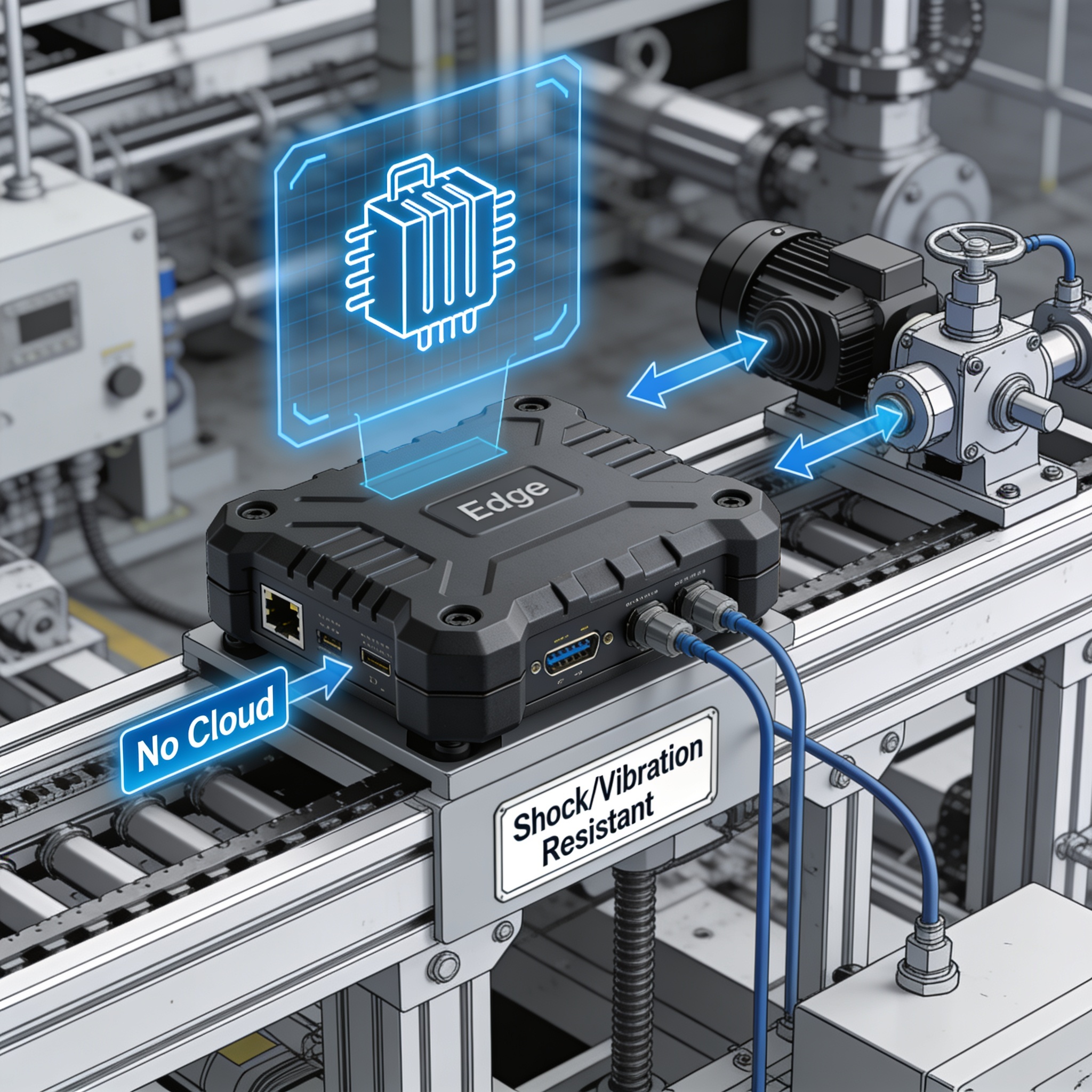
Building Local AI Agents with TinyLLMs and Edge Computing for Offline Industrial Automation
How to design, deploy, and operate local AI agents using TinyLLMs on edge devices for resilient offline industrial automation.
Building Local AI Agents with TinyLLMs and Edge Computing for Offline Industrial Automation
Introduction
Industrial automation increasingly demands intelligence at the edge: local decision-making, immediate anomaly detection, and resilience when connectivity drops. Large cloud models are powerful but brittle for factory floors that must operate offline, secure, and with tight latency budgets.
This post shows how to build practical local AI agents using TinyLLMs (compact language models optimized for edge) and edge computing patterns. You’ll get an architecture template, design patterns for robustness and safety, an implementable local-agent loop with a code example, and a checklist to drive production readiness.
Assumed audience: software engineers and ML engineers working on industrial IoT, control systems, or embedded inference.
Why local agents for industrial automation
- Latency: On-device inference avoids round-trips and ensures deterministic control timelines.
- Resilience: Devices must continue operating if network or cloud is unavailable.
- Privacy & Safety: Sensitive telemetry remains on-prem and control loops are under local governance.
- Cost and bandwidth: Continuous streaming to cloud increases costs and creates dependency.
TinyLLMs make this practical: they shrink model size, reduce CPU/GPU needs, and enable natural-language style reasoning or policy generation on-device.
Architecture overview
At a high level, a local AI agent architecture has three layers:
- Device layer: sensors, actuators, controllers, and a compute node (edge compute module).
- Agent runtime: TinyLLM model, input preprocessors, policy layer, safety filters, and local state store.
- Sync/orchestration: Optional periodic sync to a central server for model updates, metrics, and retraining data.
Hardware: pick the right edge node
- Minimal: ARM Cortex-A-class with NPU support for microcontrollers running TinyLLM micro-binaries.
- Typical: ARM64 single-board computers (e.g., Raspberry Pi 4, Jetson Nano) or industrial PCs for models with larger parameter counts.
- High throughput: Industrial GPUs or accelerators (Intel Movidius, Coral, AWS Panorama) for low-latency vector ops.
Choose hardware by profiling your model latency and memory. A TinyLLM that fits in memory and runs at target latency on your device is the single biggest gating factor.
Model: TinyLLMs for control and reasoning
TinyLLMs are compact transformer-based models, distilled or quantized to run locally. Use them for:
- Interpreting engineer instructions (natural language to parameterized action templates).
- Short-term context reasoning (combining sensor history into concise summaries).
- Diagnostics and anomaly explanations for operators.
They are not a replacement for hard real-time controllers. Use them to augment rule-based controllers and to provide higher-level policy suggestions.
Runtime and orchestration
- Local agent loop: collect data, run the model, post-process the output into control actions, run safety checks, execute or enqueue actions.
- Supervisor process: monitors resources, restarts agent on failure, enforces CPU/GPU limits.
- Update channel: secure, authenticated model and config updates that apply during maintenance windows.
Design patterns for robust local AI agents
Offline-first, eventual sync
Agents must be fully functional offline. Design a sync protocol that batches telemetry and training triggers, avoids blocking the control loop, and is resumable.
Deterministic control points
Local agents should propose actions, but the final enforcement should run through deterministic safety filters implemented in native code. Keep ML proposals auditable and reversible.
Graceful degradation
Define fallbacks when the agent fails or produces low-confidence outputs: revert to rules-based policies, issue operator alerts, and capture diagnostics.
Explainability and auditing
Store compact rationale traces alongside actions: input summaries, model confidence, safety gate decisions. Keep trace sizes small (summaries, not full logs) to preserve storage and bandwidth.
Model versioning & rollback
Each deployment must tag model version and config. Implement quick rollback to a golden model if the edge detects performance regressions.
Implementation: step-by-step local agent loop
Below is a concise implementation pattern for a local agent written in Python-like pseudocode. The loop shows data collection, local TinyLLM inference, safety gating, and action execution.
# Agent startup
load_config(path="/etc/agent/config.json")
model = load_tinyllm(model_path="/opt/models/tinyllm-v1")
state_store = open_local_state("/var/lib/agent/state.db")

while True:
    # 1) Collect sensor snapshot (sensors read at hardware drivers level)
    snapshot = read_sensors()

    # 2) Preprocess into compact context (limit tokens)
    context = summarize_for_model(snapshot, history=state_store.recent(10))

    # 3) Model inference (returns structured suggestion)
    suggestion = model.infer(context)

    # 4) Post-process and check confidence
    action = translate_suggestion_to_action(suggestion)
    if suggestion.confidence < 0.6:
        log_warning("Low model confidence", suggestion.confidence)
        fallback_action = get_rules_based_action(snapshot)
        action = prefer_safest(action, fallback_action)

    # 5) Safety gate (deterministic, fast checks)
    if not safety_gate_ok(action, snapshot):
        log_error("Safety gate blocked action")
        action = get_safe_noop()

    # 6) Execute or enqueue action for controller at the required rate
    enqueue_action_to_controller(action)

    # 7) Persist trace for auditing and possible retraining
    persist_trace(state_store, context, suggestion, action)

    # 8) Sleep to the next control tick
    sleep_until_next_tick()
Notes on the code above:
- Keep the model inference asynchronous or on a dedicated thread if inference time varies.
- Roll the state store; store compact summaries to limit disk usage.
Configuration example
Use a compact JSON config to define model and thresholds. Inline JSON must be escaped when included in text, for example: { "model": "tiny-llm-v1", "confidenceThreshold": 0.6 }.
Safety and certification considerations
Industrial settings demand safety. Key points:
- Treat ML outputs as advisory unless validated by a certified safety path.
- Use deterministic filters written in a certifiable language (C, MISRA-compliant subsets) between ML and actuators.
- Maintain offline logs and versioned traces to support post-incident analysis.
- Ensure the update channel is signed and that devices verify signatures before applying model updates.
Monitoring and continuous improvement
- Local telemetry: CPU, memory, model latency, queue sizes, and error counters.
- Periodic telemetry sync: batch anonymized traces for retraining when connectivity allows.
- Canary deployments: roll new models to a subset of devices before fleet-wide updates.
Deployment checklist
- Hardware validation: model latency & memory fit validated across target devices.
- Safety gates implemented and unit-tested with boundary inputs.
- Fallback behavior defined and exercised under simulated failure.
- Secure update mechanism with signed artifacts and rollback support.
- Trace and metrics schema defined and storage bounded.
- Operator UI for viewing agent rationales and overriding actions.
Summary / Quick checklist
- Validate TinyLLM inference latency on each target device.
- Implement deterministic safety gate between agent and actuators.
- Ensure offline-first operation with resumable sync.
- Keep model outputs auditable and store compact rationale traces.
- Provide secure, signed update and rollback mechanism.
- Canary new models and monitor resource usage and accuracy.
Local AI agents with TinyLLMs let industrial systems gain contextual reasoning without sacrificing latency, resilience, or safety. Build them with clear separation: ML for proposal and native code for enforcement. Measure, log, and iterate — and always design for safe fallback.