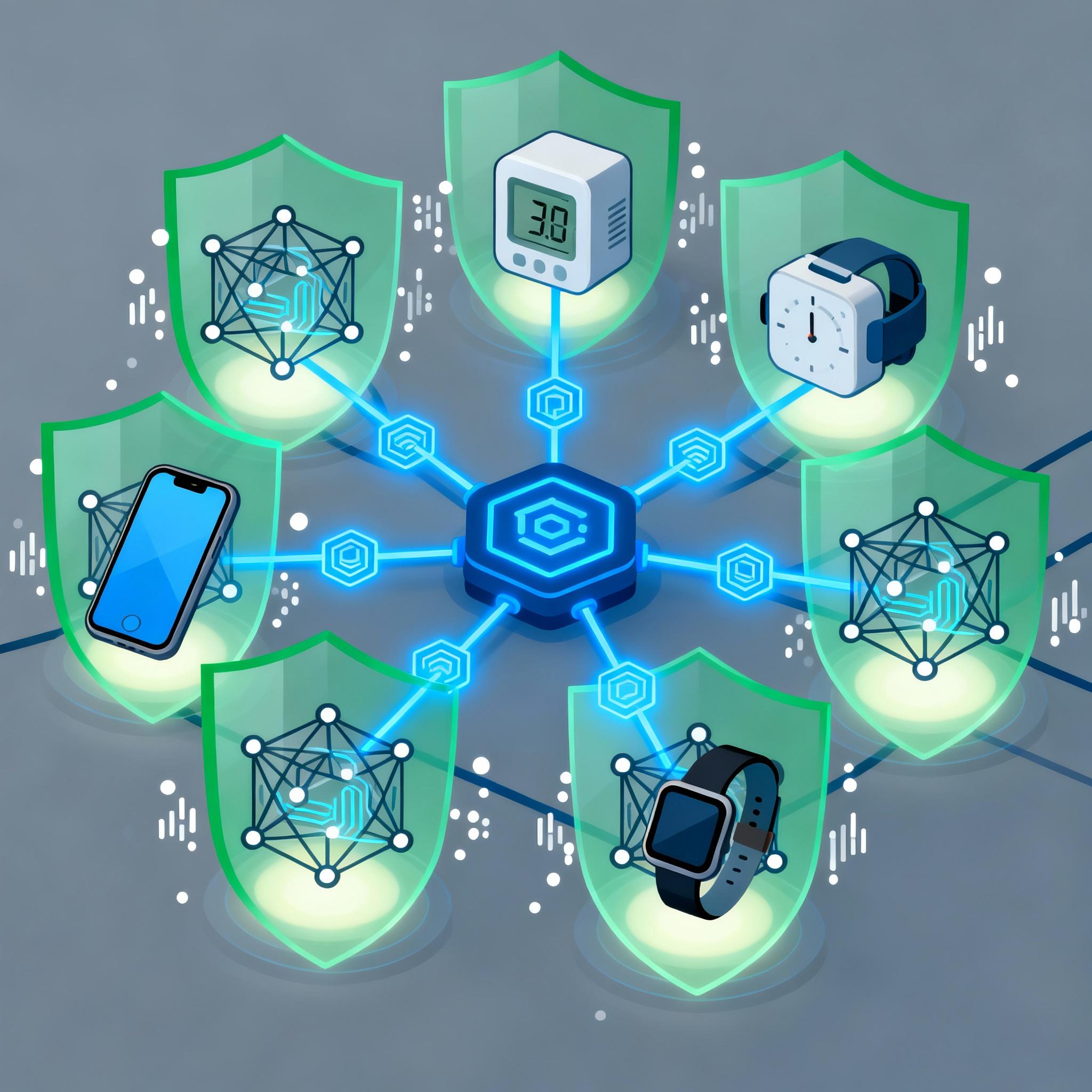
Building Privacy-Preserving On-Device AI for Smart Devices
A practical blueprint for deploying federated learning, differential privacy, and secure aggregation on edge devices.
Building Privacy-Preserving On-Device AI for Smart Devices
Intro — why privacy on-device matters now
Edge devices — phones, IoT sensors, wearables, smart appliances — collect highly personal signals. Sending raw data to the cloud is increasingly unacceptable for privacy, latency, and bandwidth reasons. The better option: train and adapt models on-device while preserving user privacy.
This guide gives a practical, engineer-first blueprint for building privacy-preserving on-device AI using federated learning (FL), differential privacy (DP), and secure aggregation (SA). You will get architecture patterns, a deployment checklist, and a concise code example showing the components that glue together in production.
High-level architecture
Components and flow
- Orchestrator (server): coordinates rounds, aggregates model updates, manages client selection.
- Clients (edge devices): perform local training on private data, apply DP mechanisms locally or coordinate with server for noise budgeting, and participate in secure aggregation.
- Communication layer: efficient parameter deltas, compression, and retry logic.
- Privacy auditor: logs DP budgets, monitors noise and clipping parameters.
Typical flow:
- Server publishes a global model and FL round spec.
- Selected clients load the model, run local training (1–5 epochs), produce updates (gradients or weights delta).
- Clients apply local DP (optional) and participate in secure aggregation so the server only sees an aggregated sum.
- Server updates the global model using the aggregate, evaluates, and repeats.
Architectural trade-offs
- Local DP adds protection even if aggregation fails, but it requires more noise (higher utility loss) than centralized DP.
- Secure aggregation protects raw updates from the server, but adds protocol complexity and coordination/availability constraints.
- Communication budget versus model capacity: compress updates (Top-K, quantization) and leverage sparsity.
Federated learning: practical setup
Client selection and sampling
Randomized, stratified, or availability-based sampling affects convergence and fairness. Favor stable, reliably-connected clients for synchronous rounds; use asynchronous aggregation for unstable fleets.
- Use client sampling fraction f ∈ (0, 1]. Typical values: f = 0.01–0.1 depending on fleet size.
- Track per-client participation for fairness and privacy accounting.
Local training loop (key knobs)
- Local epochs: 1–5 (more epochs reduce communication but increase drift).
- Batch size: constrained by device memory; smaller batch sizes increase variance.
- Learning rate schedule: simple decay or server-driven LR updates.
Update representation
Send weight deltas instead of full model every round. Consider delta compression:
- Top-K sparsification
- Quantization (8-bit or lower)
- Sketching (CountSketch)
Compression interacts with secure aggregation; ensure compatibility.
Differential privacy — DP-SGD and practical tips
DP provides quantifiable privacy guarantees. The widely used mechanism for deep learning is DP-SGD, which combines gradient clipping and noise addition.
Key parameters:
- Clipping norm C: bound per-example or per-batch gradient norm.
- Noise multiplier σ: noise calibrated to desired epsilon (privacy budget).
- Delta δ: typically set to 1 / number_of_examples or lower.
Practical recipe:
- Clip gradients per-example to C.
- Aggregate clipped gradients across local batches on-device.
- Add Gaussian noise N(0, σ^2 C^2 I) to the aggregated gradient before sending.
- Use a privacy accountant (Moments Accountant or RDP) to track cumulative epsilon across rounds.
Example inline config for round-level hyperparameters: { "clients": 100, "rounds": 500, "clip_norm": 1.0, "noise_multiplier": 1.2 }.
Notes:
- On-device per-example clipping can be expensive; use micro-batching or approximate per-sample gradients when necessary.
- Larger models need larger clipping norms which increase noise scale; consider per-layer clipping.
Secure aggregation — protecting the server from seeing individual updates
Secure aggregation ensures the server only learns the aggregate sum of client updates. Classic protocols use pairwise masking and cryptographic primitives.
Design points:
- Handling dropouts: use threshold cryptography or masking schemes that tolerate client loss.
- Scalability: pairwise secrets scale poorly; use efficient protocols like SecAgg variants or MPC-based schemes tailored for FL.
- Implementation: use asynchronous key exchange and a protocol that tolerates stragglers.
When to use SA:
- Required if server is not fully trusted.
- Combine SA with DP to get strong end-to-end guarantees; SA prevents exposure of raw updates while DP limits information in the aggregate.
End-to-end example: client update (PyTorch-style pseudo-code)
Below is a compact on-device training loop that demonstrates local training, clipping, noise addition, and sending an update. This is a template — adapt for your stack and secure aggregation layer.
# Pseudo-code: on-device client update
model.train()
optimizer.zero_grad()

# local dataset: an iterable of (x, y)
for epoch in range(local_epochs):
    for x, y in dataloader:
        predictions = model(x)
        loss = loss_fn(predictions, y)
        loss.backward()  # compute gradients

        # Collect per-parameter gradient norms into a single norm
        total_norm = 0.0
        for p in model.parameters():
            if p.grad is not None:
                total_norm += (p.grad.data.norm(2).item()) ** 2
        total_norm = sqrt(total_norm)

        # Clip gradients
        clip_coef = min(1.0, clip_norm / (total_norm + 1e-6))
        for p in model.parameters():
            if p.grad is not None:
                p.grad.data.mul_(clip_coef)

        # Apply optimizer step locally
        optimizer.step()
        optimizer.zero_grad()

# After local training, compute model delta
delta = [ (p.data - p_start.data).cpu().numpy() for p, p_start in zip(model.parameters(), model_start.parameters()) ]

# Add Gaussian noise for DP (before sending)
for d in delta:
    d += np.random.normal(loc=0.0, scale=noise_multiplier * clip_norm, size=d.shape)

# Optionally compress delta here (Top-K / quantize)

# Participate in secure aggregation: send masked/compressed delta
send_secure_aggregate(mask_and_package(delta))
Notes on adapting this snippet:
- Replace per-parameter numpy conversion with streaming uploads for memory constrained devices.
- Use hardware RNG for cryptographic noise when available.
- Prefer fixed-point or quantized representations when bandwidth is tight.
Deployment considerations and hardening
- Privacy accounting: central service must track epsilon per user. Use Renyi DP accountant for tight composition.
- Auditing: log protocol events, participation, and per-round noise multipliers (avoid logging raw gradients).
- Failure modes: if secure-aggregation fails, have a fall-back (e.g., require re-run or skip the round).
- Testing: use simulation with varying client availability and malicious clients to validate robustness.
- Regulatory: maintain data retention and deletion policies; allow users to opt-out and request model biases be addressed.
Performance and model design tips for edge
- Smaller models: use MobileNet, quantized transformers, or TinyML models tuned for on-device inference and training.
- Layer freezing: freeze large embedding or early layers and only train small personalization heads to reduce computation, communication, and DP noise impact.
- Adaptation frequency: fewer rounds with larger client participation may be preferable to many small rounds depending on churn.
Summary / Quick checklist
- Architecture
- Design FL orchestrator with robust client selection and retry logic.
- Implement secure aggregation protocol that tolerates realistic dropouts.
- Differential Privacy
- Decide DP mode: local DP, central DP, or hybrid.
- Choose clipping norm C and noise multiplier σ; run privacy accountant.
- Client-side
- Implement per-example or micro-batch clipping.
- Add calibrated Gaussian noise to updates.
- Compress updates (Top-K, quantization) before transmission.
- Operational
- Maintain an auditable privacy budget ledger.
- Test at scale with realistic churn and adversarial clients.
- Provide opt-out and data deletion flows.
Building privacy-preserving on-device AI is an engineering exercise in layered defenses: combine FL for decentralization, DP for a formal privacy guarantee, and SA to reduce server trust. Start small — a frozen base model with a tiny personalization head — measure utility vs. privacy, then iterate on clipping, noise, and aggregation protocol choices based on your fleet’s constraints.
If you want, I can produce a concrete integration plan for a specific stack (TensorFlow Federated, PySyft, or a custom PyTorch + SecAgg flow) with recommended hyperparameters for your dataset and device profile.