Federated Learning in the Real World: Bridging Privacy, Security, and Compliance for Enterprise AI in 2025
Practical guide for engineers adopting federated learning in enterprises — balancing privacy, security, and regulatory compliance for production ML in 2025.
Federated Learning in the Real World: Bridging Privacy, Security, and Compliance for Enterprise AI in 2025
Federated learning (FL) moved from research demos to production in pockets during the early 2020s. By 2025, the biggest challenge for engineering teams isn’t whether FL works — it’s whether it meets enterprise constraints: privacy guarantees, security posture, and regulatory compliance. This post is a practical playbook for engineers and architects building FL pipelines that must satisfy legal teams and protect customer data while remaining operationally viable.
What enterprise teams should expect from FL
Federated learning is not a single technology — it’s an architectural pattern. Expect the following trade-offs and constraints:
- Latency: updates arrive asynchronously and unpredictably.
- Heterogeneity: clients have different compute, data distributions, and availability.
- Limited observability: raw data never leaves client devices, so debugging requires new tooling.
Answering these well requires combining cryptographic techniques, statistical privacy mechanisms, robust software engineering, and documented governance.
Core privacy and security controls
Below are the primary controls you should evaluate and combine.
Differential privacy (DP)
DP is the quantitative backbone for privacy guarantees. In FL you can apply DP at two points:
- Client-side DP: add noise before sending updates. Best for strong local guarantees and simple compliance messaging.
- Server-side DP: apply noise during aggregation. Less noise required but requires trust in the aggregation service.
Practical tip: audit the effective epsilon across rounds. Composition accumulates privacy loss; use advanced composition bounds or the moments accountant.
Secure aggregation
Secure aggregation ensures the server learns only the aggregated update, not individual client updates. Implementations vary from simple encryption to multiparty computation (MPC).
- For large cohorts, pairwise-secret schemes or threshold homomorphic encryption work well.
- For small cohorts, MPC overhead can be significant.
Secure aggregation pairs well with server-side DP — secure aggregation prevents the server from inspecting raw updates, DP bounds leakage from the final aggregate.
Authentication, attestation, and integrity
FL surfaces new attack vectors: malicious clients might send poisoned updates, or compromised devices may leak keys.
- Use mutual TLS for transport and client certificates for identity.
- Employ hardware attestation (TPM/TEE) where available to ensure model training code and keys are anchored to a trusted environment.
- Version and sign model manifests and update packages.
Supply-chain and model poisoning defenses
Attacks to consider:
- Targeted poisoning: a client injects a small, high-impact update.
- Sybil attacks: an adversary controls many clients to bias aggregated updates.
Mitigations:
- Robust aggregation (trimmed mean, median, Krum).
- Client reputation scoring and rate limits.
- Anomaly detection on gradient distributions.
Compliance: GDPR, CCPA, HIPAA and beyond
Regulators are pragmatic: they want documented risk control and evidence. For FL, the compliance narrative should cover:
- Data minimization: show that raw data never leaves clients.
- Purpose limitation: tie the FL training purpose to a business case and consent.
- Data subject rights: design processes for access, deletion, and portability where applicable.
- DPIA (Data Protection Impact Assessment): document the flow, risks, and mitigations.
Important operational hooks:
- Logging: keep an audit trail of cohorts, model versions, and cryptographic keys. Logs must avoid storing raw data.
- Consent signals: integrate consent state into client selection for training rounds.
Architecture patterns and deployment models
Choose the pattern by risk profile and operational constraints.
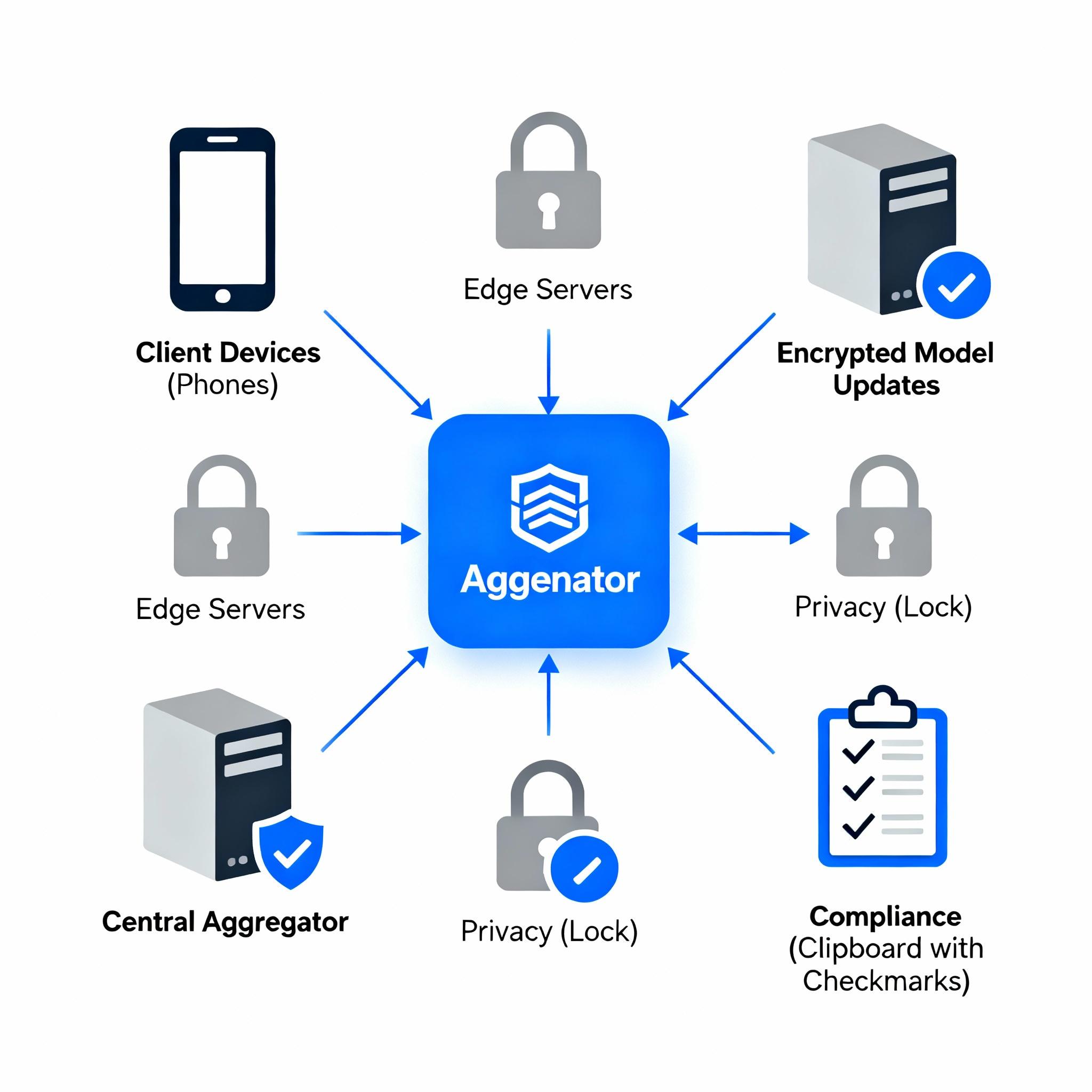
Central aggregator with secure aggregation
Most common: central server orchestrates rounds, clients compute updates and send encrypted updates for secure aggregation.
Pros: simple orchestration, scalable. Cons: centralized target for availability and compliance reviews.
Hierarchical FL
Intermediate aggregators (edge or regional) aggregate client updates before passing to central server.
Pros: reduces bandwidth, aligns with regulatory data residency. Cons: increased complexity and trust boundaries.
Peer-to-peer or fully decentralized
Eliminates single aggregator but increases protocol complexity and is hard to govern.
Choose hierarchical FL for enterprises with cross-border regulations.
Operational considerations
Monitoring and observability
You cannot inspect raw data, but you need health signals:
- Cohort-level statistics: update norms, loss curves, and delta distributions.
- Drift detection: track validation loss on held-out central data or proxy sets.
- Client-level telemetry: uptime, successful round contributions, hardware/OS versions.
Maintain separate logs for security auditing and operational metrics.
Model governance and versioning
Treat global models as regulated artifacts:
- Sign every model release and embed provenance metadata (dataset tags, cohort size, training hyperparameters).
- Keep the ability to roll back quickly and to quarantine suspect model versions.
Cost and latency engineering
FL can increase network and compute costs. Practices to control cost:
- Client selection heuristics: pick clients based on connectivity and compute class.
- Update compression: quantization, sparsification.
- Adaptive round scheduling: reduce frequency when improvements plateau.
Example: simple client training loop
The following is a minimal Python-style client loop to illustrate practical points: local training, clipping updates (for DP), and sending updates to the server. This is a structural example — adapt to your stack.
# client-side pseudo-code
model = load_local_model()
data = load_local_dataset()
optimizer = SGD(model.parameters(), lr=0.01)

for epoch in range(local_epochs):
    for batch in data:
        loss = model.compute_loss(batch)
        loss.backward()
        optimizer.step()
        optimizer.zero_grad()

# compute model delta
delta = model.get_weights() - model.prev_weights()

# clip update for DP
norm = l2_norm(delta)
max_norm = 1.0
if norm > max_norm:
    delta = delta * (max_norm / norm)

# optionally add noise for local DP
noise_scale = sigma * max_norm
delta += gaussian_noise(scale=noise_scale, shape=delta.shape)

# encrypt and send
encrypted = secure_encrypt(delta, server_public_key)
send_update(encrypted)
Notes: clamp updates before noise, and ensure client libraries have deterministic serialization to support secure aggregation.
Example inline JSON config (audit-friendly)
When you publish a small config snippet in documentation or manifests, wrap JSON inline and escape curly braces. For example: { "learning_rate": 0.01, "local_epochs": 5 }. Keep such configs in a signed, immutable repository.
Attack surface and threat model checklist
- Data leakage via model outputs: test for membership inference and model inversion attacks.
- Compromised clients: assume a fraction of clients are malicious; test robust aggregation strategies under simulated Sybil ratios.
- Infrastructure compromise: enforce key rotation, short-lived keys, and HSM-backed key storage.
> Practical mantra: assume client compromise. Design for graceful degradation.
Integration with ML lifecycle tools
Federated pipelines must plug into existing CI/CD and MLOps tools:
- Automated validation: evaluate global model on a held-out validation set before rollout.
- Canary deployments: roll out model versions to a small subset of users and monitor metrics.
- Continuous auditing: automate DPIA updates when key design parameters (e.g., epsilon, cohort sizes) change.
Summary and actionable checklist
- Design: pick the FL pattern (central, hierarchical, or decentralized) based on regulatory and latency needs.
- Privacy: decide local vs server DP and compute the cumulative epsilon across rounds.
- Security: implement secure aggregation, mutual auth, and hardware attestation when available.
- Robustness: add robust aggregation and client reputation to mitigate poisoning and Sybil attacks.
- Compliance: document DPIAs, consent flows, and data minimization; maintain signed configs and provenance metadata.
- Operations: add cohort-level observability, automated validation gates, and ready rollback mechanisms.
Quick checklist to start a project
- Define threat model and required privacy guarantees.
- Choose aggregation and DP strategy; compute expected epsilon.
- Implement mutual authentication and transport encryption.
- Add robust aggregation and monitoring for anomalous updates.
- Prepare DPIA and legal artifact package; get sign-off before production.
Adopting federated learning in 2025 demands more than an algorithm: it requires engineering the entire stack — cryptography, ML, observability, and compliance — to work together. Use the checklist above to turn FL from a research novelty into a repeatable, auditable enterprise capability.