From Prompts to Precision: Building Explainable Autonomous AI Agents for Real-Time Incident Response in Zero-Trust Networks
Design practical, explainable autonomous AI agents for real-time incident response inside zero-trust networks. Architecture, prompts, explainability, and code.
From Prompts to Precision: Building Explainable Autonomous AI Agents for Real-Time Incident Response in Zero-Trust Networks
Introduction
Modern security operations teams are overwhelmed by alert volume, attacker speed, and complex, distributed architectures. Autonomous AI agents promise to close the gap by taking rapid, auditable actions: contain a host, rotate keys, update firewall rules. But deploying autonomous agents inside zero-trust networks raises three hard requirements: low-latency decisioning, strict least-privilege enforcement, and explainable actions for audits and human-in-the-loop verification.
This post is a practical playbook for engineers: how to design, build, and operate explainable autonomous agents for real-time incident response inside zero-trust networks. No theory-heavy detours — just architecture patterns, prompt and memory design, enforcement controls, and a concrete agent loop example you can adapt.
Core design goals
- Predictability: actions must be deterministic or bounded non-deterministic to enable reproducibility.
- Explainability: every decision must carry an audit-friendly rationale and a data provenance trail.
- Least privilege: the agent’s capabilities map to narrow, auditable roles with time-limited tokens.
- Latency: from detection to containment should meet your SLA (often < 30 seconds for critical paths).
- Human oversight: built-in checkpoints for high-risk actions with escalation policies.
Architecture overview
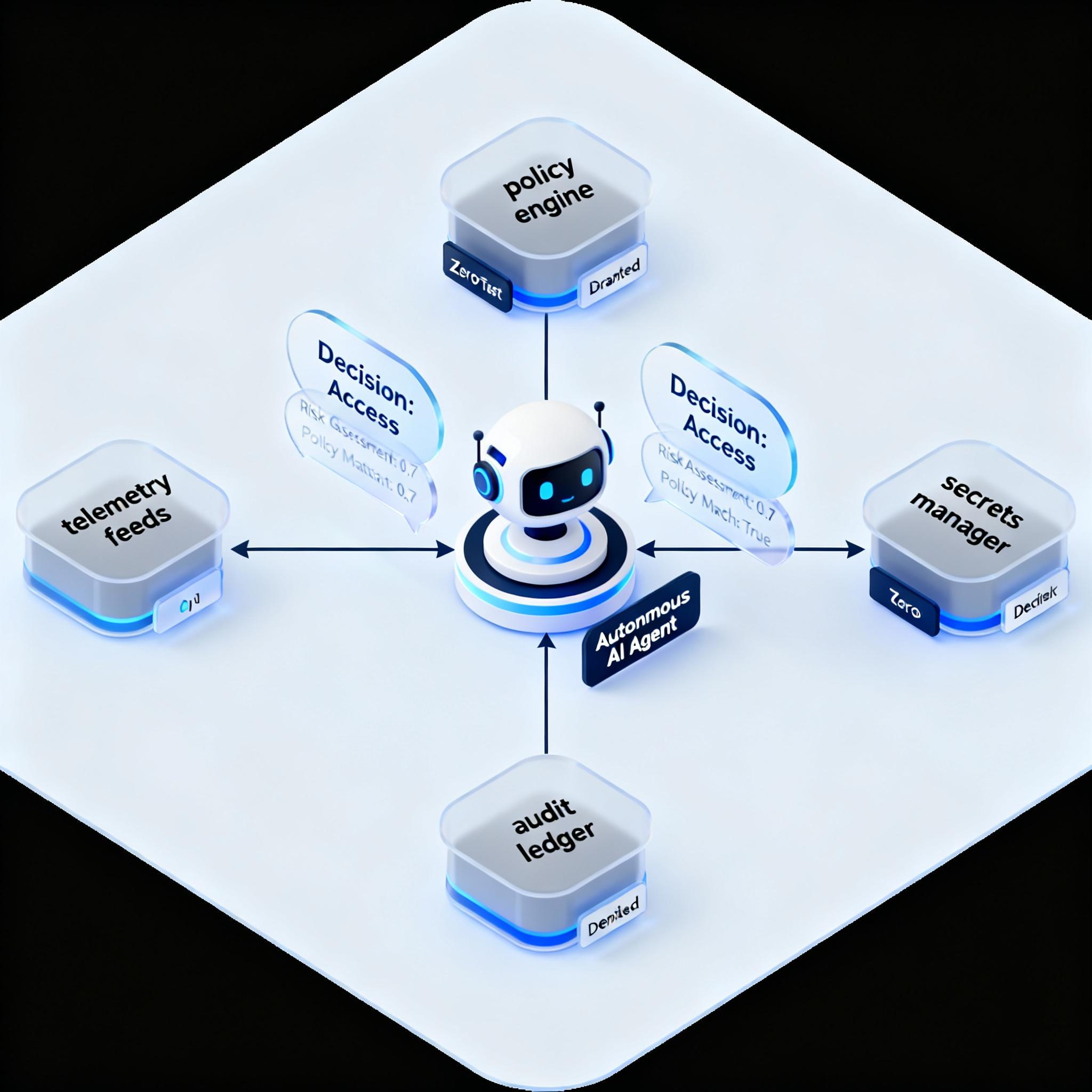
Components
- Telemetry and detection: SIEM, EDR, NDR, cloud audit logs produce normalized events.
- Orchestration layer: message bus or event broker (Kafka, Redis Streams) that distributes incidents.
- Policy engine: authoritative source for response playbooks and approval policies (OPA, custom rules).
- Agent runtime: the autonomous agent containers that observe events, plan, execute, and explain.
- Audit store: append-only event store for action logs, explanations, and provenance (immutable storage).
- Secrets and credential manager: short-lived certificates, vault-issued tokens (HashiCorp Vault, AWS STS).
Diagram (logical): detection → broker → agent runtime (+policy check) → action via least-privilege connector → audit store.
Trust boundaries and zero-trust constraints
- Each agent instance runs with a minimal identity and can request scoped tokens from the secrets manager.
- Network segmentation enforces that agents only reach approved control-plane endpoints (no lateral admin privileges).
- Every outbound API call is intercepted by a policy proxy that validates intent against stored playbooks.
Prompt engineering and memory for correctness
Autonomous agents are only as good as the prompts and state they rely on. Two engineering patterns matter:
1) Structured prompts with deterministic scaffolding
Avoid free-form prompts. Use templated prompts with explicit sections: context, constraints, required outputs, step-by-step plan, and confidence score. Example fields you should always provide: incident summary (5 lines), last-known-good indicators, current token/credential scope, and policy blockers.
A minimal template (pseudocode):
- Context: incident id, timestamp, telemetry snippets.
- Constraints: actions allowed, max-impact level, required approvals.
- Ask: required outputs such as
plan,action-steps,explainability-note.
2) Short-term memory + immutable provenance
Keep two memory tiers:
- Ephemeral memory: short, contextual facts used within a single decision (recent events, current tokens). TTL < 60s.
- Provenance ledger: append-only records of all inputs, decisions, and tokens used for auditing.
Ephemeral memory ensures the model reacts to real-time state; the provenance ledger is essential for forensic and compliance needs.
Explainability and traceability
Explainability isn’t optional. Make the agent produce three artifacts for every decision:
- Decision Plan: the high-level reasoning steps the agent will take.
- Data Provenance: which logs, queries, and signals influenced the decision (with stable identifiers and timestamps).
- Confidence and Rationale: a short justification plus a confidence score and fallback actions if confidence is low.
Store these artifacts in the audit store and surface them in the SOAR console. Use structured schemas for easy parsing by downstream tools.
Enforcement: policy, approvals, and least privilege
Enforce controls at three layers:
- Pre-decision policy check: when the agent proposes a plan, submit the plan to the policy engine which can approve, deny, or require escalation.
- Capability gating: the runtime only issues requests through connectors that require scoped tokens; the connectors verify that the action in the plan matches the token scope.
- Post-action reconciliation: after any change, run a verification workflow to confirm intended state and roll back if divergence detected.
Human-in-the-loop: configure playbooks so that any action with blast radius > threshold or involving sensitive assets requires an explicit human approval event before execution.
Real-time orchestration and latency optimizations
Practical tips to meet tight SLAs:
- Pre-warm token issuance so the agent can obtain scoped credentials in milliseconds.
- Cache frequently used policy evaluations but tag cache entries with a short TTL and revalidate for high-risk decisions.
- Use binary or compact telemetry encodings on the wire to minimize serialization overhead.
- Push the minimum context needed to the agent; avoid sending entire logs unless asked by the agent plan.
Example: lightweight agent loop (Python-like pseudocode)
The following shows an agent decision loop that demonstrates inputs, planning, policy check, execution, and explainability artifacts. This is a simplified example for clarity.
# agent main loop
while True:
    incident = broker.consume("incidents")
    context = telemetry.fetch_context(incident.id, window_s=30)

    # Build deterministic prompt for the reasoning model
    prompt = {
        "incident_id": incident.id,
        "summary": incident.summary,
        "recent_signals": context.signals,
        "constraints": policy.get_constraints(incident.type)
    }

    # Ask the reasoning model for a plan and rationale
    plan_response = reasoning_model.plan(prompt)

    # Always store the proposed plan in the provenance ledger before execution
    audit.record_proposed(incident.id, plan_response)

    # Policy engine validates the proposed plan
    policy_decision = policy.evaluate(plan_response)

    if policy_decision.status == "requires_human":
        human = notifier.request_approval(incident.id, plan_response)
        if not human.approved:
            audit.record_denied(incident.id, human)
            continue

    if policy_decision.status == "denied":
        audit.record_denied(incident.id, policy_decision)
        continue

    # Execute steps using least-privilege connectors; each connector validates scope
    for step in plan_response.steps:
        connector = connector_registry.get(step.target)
        connector.execute(step)
        audit.record_action(incident.id, step)

    # Post-action verification
    verification = verifier.check_state(incident.id, plan_response.expected_state)
    audit.record_verification(incident.id, verification)

    # Emit final explainability artifact
    explain = {
        "incident_id": incident.id,
        "plan": plan_response.summary,
        "confidence": plan_response.confidence,
        "data_provenance_refs": plan_response.provenance_refs
    }
    audit.record_explainability(explain)
This loop shows the three required explainability artifacts (proposed plan, action records, final explanation), the policy gate, and the least-privilege execution connectors.
Observability and testing
- Test the agent in a controlled stage environment with synthetic incidents and black-box checks on blast radius.
- Simulate network partitions and credential expiry to validate fallback behaviours.
- Run chaos tests where the policy engine is deliberately slow or returns transient errors.
- Collect metrics: time to propose, time to approve, time to execute, and mean time to verify.
Operational checklist (summary)
- Establish minimal identity for agent runtime and integrate with ephemeral credential manager.
- Build a structured prompt template and short-lived ephemeral memory TTL.
- Implement a policy engine with pre-decision checks and human-in-the-loop gates.
- Ensure every proposal and action is recorded in an append-only audit store with provenance refs.
- Use connectors that enforce scope-based execution and verify post-action state.
- Pre-warm tokens and cache low-risk policy evaluations to meet latency SLAs.
- Test with synthetic incidents, chaos scenarios, and replay real incidents for validation.
Closing: balance autonomy with accountability
Autonomous agents can drastically reduce response time, but they change your risk model. The most resilient systems combine tightly-scoped capabilities, deterministic prompts, and rigorous explainability. Build your agents with auditability and policy checks from day one — precision is not just about fewer false positives, it’s about being able to explain and justify every action when an auditor, operator, or your future self asks “Why did you do that?”.
> Quick checklist: > > - Structured prompts and ephemeral memory > > - Policy gate + human approvals for high-risk actions > > - Least-privilege connectors and pre-warmed tokens > > - Append-only provenance ledger and explainability artifacts > > - Continuous testing and verification