Guardrails in practice: A developer’s playbook for secure, auditable foundation model deployments (data provenance, prompt safety, and red-teaming)
Practical guide for developers to build guardrails around foundation models: data provenance, prompt safety, and automated red-teaming for secure, auditable deployments.
Guardrails in practice: A developer’s playbook for secure, auditable foundation model deployments (data provenance, prompt safety, and red-teaming)
Deploying foundation models into production without guardrails is asking for incidents and compliance headaches. This post is a developer-focused playbook: specific controls you can implement today to make model behavior auditable, inputs safe, and systems resilient to adversarial probes. No fluff — concrete patterns, an end-to-end example, and a checklist you can apply to your API or service.
What this guide covers
- A compact threat model and goals for guardrails
- Provenance and lineage: capture what matters for audits and incident investigations
- Prompt safety and input validation: runtime checks and sanitizers
- Automated red-teaming and monitoring: continuous adversarial testing and telemetry
- End-to-end example with code for an audit logging middleware
Audience: engineers running model inference behind APIs, MLOps/DevOps, and security engineers advising AI services.
Threat model and objectives
You’re protecting against three practical risks:
- Undesired outputs: hallucinations, leaks of sensitive data, or content that violates policy.
- Privilege escalation via prompt injection: attackers controlling or influencing prompts to reveal secrets or change behavior.
- Compliance and forensics gaps: inability to trace how a problematic output was generated.
Core objectives for guardrails:
- Make every inference auditable — record the chain of custody for prompts and data.
- Stop malicious or harmful inputs before they reach the model when possible.
- Continuously probe your deployed surface with adversarial tests and use results to harden controls.
Data provenance and lineage — what to capture and why
Provenance is forensic fuel. If a customer reports a bad output, you need to reconstruct the path that created it.
At minimum, capture these fields for every inference request:
request_id— globally unique identifier for the transaction.timestamp— ISO 8601 UTC.user_idor session context — to scope investigations.input_hash— stable hash of the prompt/user data.prompt_template_id— if you use templates, store the template reference and the filled template.modelandmodel_version— exact model identifier.system_instructions— any system or assistant messages fed into the model.tool_calls— if your pipeline invokes tools or retrieval systems, log the tool name, inputs, and outputs.response(or response_hash) — for privacy, you can store the hash and optionally the full output if retention allows.safety_flags— results of runtime checks like toxicity or PII detection.
Why hashes? Storing input_hash and response_hash lets you prove content existed without persisting sensitive text in plain form. But logs should be selectable per compliance needs: some audits require full text retention.
Practical storage: push provenance records into a write-once store (append-only), and index by request_id, user_id, and timestamp. Use object storage for bulky artifacts (retrieval results, embeddings) and store pointers in the log.
Prompt safety and input validation — runtime patterns
Guardrails should run as close to the input source as possible. Implement layered checks:
- Client-side schema validation: enforce types, sizes, and allowed fields before sending requests to the server.
- Server-side sanitization and allowlisting: normalize inputs, remove unexpected control characters, and enforce maximum prompt length.
- Prompt templates with explicit placeholders: avoid concatenating raw user text into system-level instructions.
- Runtime safety filters: run quick classifiers to detect PII, toxicity, or prompt injection patterns and reject or rewrite requests.
Example policies to enforce:
- Reject requests where user-input contains sequences used to close or modify system instructions (common prompt injection patterns).
- Strip or escape markup and shell-like constructs when you use generated outputs in command execution.
- Require user intent confirmation for high-risk actions.
Prompt templating pattern
Use explicit, minimal templates and attach metadata rather than embedding policies in user-controlled data. Example template elements:
system_instructions— immutable, audited guidance for the model.user_message— sanitized user text.context— curated, retrieval-augmented content with provenance pointers.
Treat templates as first-class versioned artifacts. When you update a template, bump prompt_template_id and capture diffs in your provenance logs.
Automated red-teaming and monitoring
Red-teaming should be continuous and automated. Key components:
- Fuzzer pool: a set of adversarial generation routines producing injection attempts, malicious prompts, and edge cases.
- Canary tests: small synthetic queries that should always be blocked or handled safely.
- Drift detection: telemetry that alerts when distributions of inputs or model outputs change meaningfully.
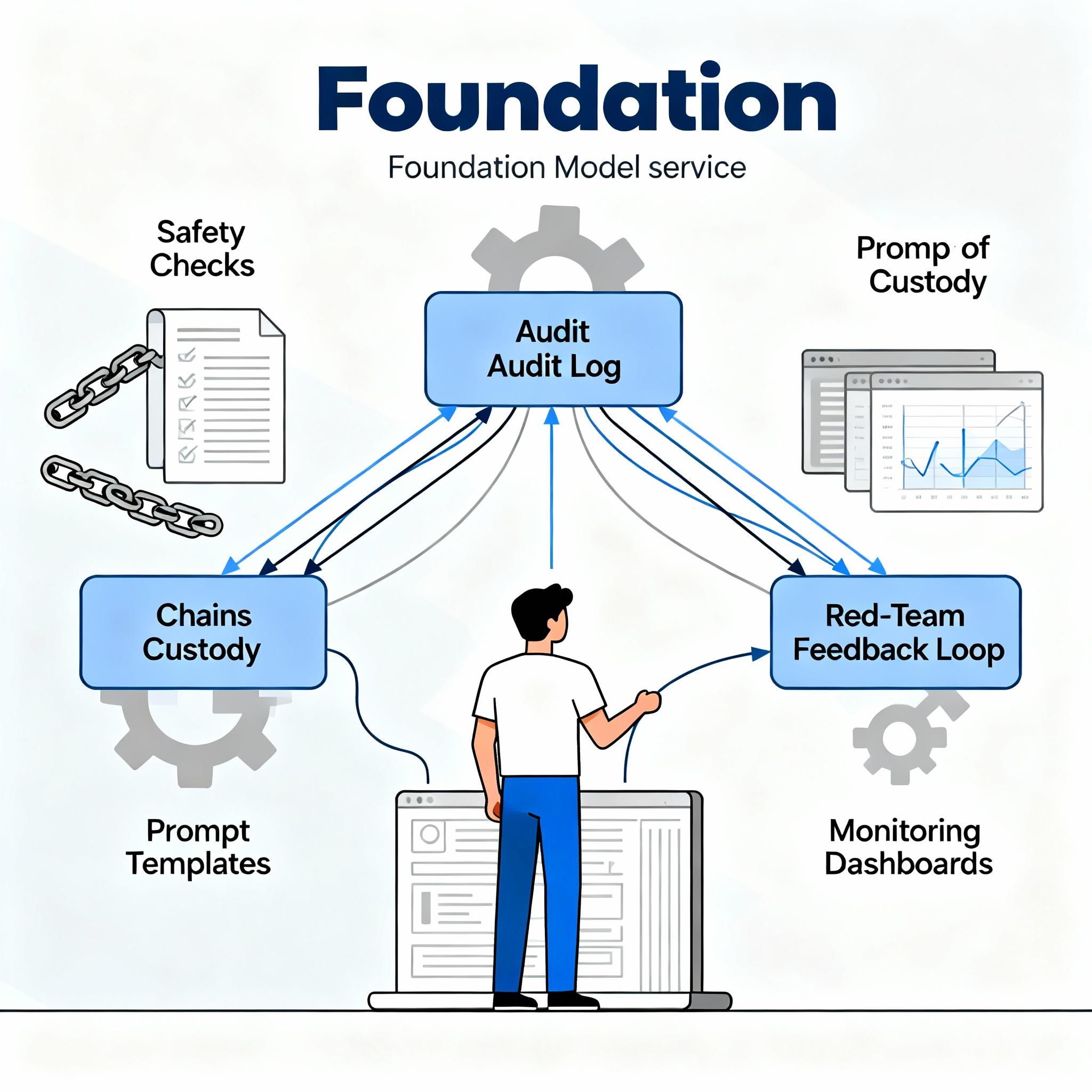
- Feedback loop: failed red-team cases create tickets, trigger template updates, or refine safety classifiers.
Implement a scheduled job that runs your latest model and prompt configuration against the fuzzer pool. Record all results in the same provenance store and tag failing cases with priority.
End-to-end example: audit-logging middleware
Below is a compact example of a server-side middleware pattern that captures provenance, runs a safety check, and forwards the request. It’s pseudocode-like but directly translatable to Python/Node servers.
# Middleware: audit log + safety check
def handle_inference_request(request):
    request_id = generate_uuid()
    timestamp = now_utc().isoformat()

    # Basic schema checks
    if 'user_id' not in request:
        return error(400, 'missing user_id')

    user_id = request['user_id']
    raw_input = request.get('input', '')

    # Sanitize and normalize
    sanitized_input = sanitize_text(raw_input)

    # Compute hashes for audit trail
    input_hash = sha256(sanitized_input)

    # Run fast safety classifiers (PII, toxicity, prompt-injection patterns)
    safety_flags = run_fast_safety_checks(sanitized_input)
    if safety_flags.get('block'):
        log_provenance(request_id, timestamp, user_id, input_hash, model=None, safety_flags=safety_flags)
        return error(403, 'input blocked by policy')

    # Construct prompt from template (versioned)
    prompt_template_id = get_active_template_id()
    prompt = fill_template(prompt_template_id, sanitized_input)

    # Record the provenance before dispatching to the model
    provenance = {
        'request_id': request_id,
        'timestamp': timestamp,
        'user_id': user_id,
        'input_hash': input_hash,
        'prompt_template_id': prompt_template_id,
        'system_instructions_id': get_system_instructions_id(),
        'model': get_model_id(),
        'safety_flags': safety_flags
    }
    append_audit_log(provenance)

    # Call model
    response = call_model(prompt)
    response_hash = sha256(response)

    # Finalize audit with response info
    append_audit_log({'request_id': request_id, 'response_hash': response_hash, 'full_response': maybe_store(response)})

    return success(response)
Notes on the example:
sanitize_textshould remove control sequences and normalize whitespace. Stronger sanitizers can strip suspicious tokens.run_fast_safety_checksare intentionally lightweight classifiers that run in milliseconds to avoid latency spikes.append_audit_logwrites to an append-only store; include RBAC so only authorized services can write.maybe_storecontrols retention policies: you might only store a hash unless the request meets criteria for full retention.
Red-teaming pipeline snippet (concept)
Integrate these steps as a scheduled pipeline:
- Generate adversarial inputs from your fuzzer pool.
- Send them through the production stack (or a staging mirror).
- Collect safety flags and outputs into a red-team dataset.
- Prioritize failures by severity and escalate to template or policy owners.
Automate remediation where safe — for example, update the fast safety classifier’s allow/block lists or add a template escape. For high-risk failures, require human review.
Observability and alerting
Monitor these signals:
- Rate of safety-flagged requests per minute.
- Fraction of requests blocked by prompt-injection detectors.
- Drift in output embeddings or classification labels (indicates model or data drift).
- Latency spikes correlated with safety checks.
Add alert thresholds that combine signal and velocity; a sudden spike in blocked requests is higher priority than a steady low rate.
Summary checklist — deployable guardrails
- Implement append-only audit logs with
request_id,timestamp,input_hash,prompt_template_id,model_version, andsafety_flags. - Version and store prompt templates and system instructions; record template IDs in provenance.
- Add server-side sanitization and fast safety classifiers that can block or quarantine requests.
- Use prompt templates with explicit placeholders and minimize direct embedding of user-controlled content into system instructions.
- Build an automated red-team pipeline that runs adversarial inputs against staging or mirrored production and records outcomes to the audit store.
- Retain artifacts according to compliance policies; use hashes when you cannot retain full text.
- Monitor safety flags, drift metrics, and red-team failure rates; wire alerts to on-call and policy owners.
Final notes
Guardrails are not a single tool — they’re a tight feedback loop between runtime controls, provenance, and continuous adversarial testing. Start by capturing clean, immutable provenance: once you can reconstruct incidents reliably, safety and red-team work becomes tractable. Implement quick, fast checks at inference time, and push expensive analysis into asynchronous pipelines that feed back into templates and policies.
Ship small, iterate fast: a simple audit log and a fast PII/toxicity filter will prevent many problems. Then scale to full red-teaming and versioned prompt governance.
Implement this playbook incrementally, and you’ll move from reactive incident response to a proactive, auditable safety posture for foundation model deployments.