On-device AI for Zero-Trust Security: Edge ML and Federated Learning for IoT Devices
Practical guide: how on-device ML and federated learning enable zero-trust threat detection across IoT at the edge.
On-device AI for Zero-Trust Security: Edge ML and Federated Learning for IoT Devices
Edge-first security is no longer aspirational—it’s a requirement. As IoT fleets scale, centralized detection models become single points of failure and privacy liabilities. On-device machine learning combined with federated learning and a zero-trust posture changes the threat-detection playbook: devices detect anomalies locally, share minimal encrypted updates, and collectively improve detection without exposing raw telemetry.
This article gives engineers a practical blueprint: architecture patterns, trade-offs, a concrete code example for local anomaly scoring and secure update flow, and an actionable checklist to get started.
Why on-device AI fits zero-trust for IoT
Zero-trust means “never implicitly trust the network or endpoints.” For IoT, that implies three technical truths:
- Devices must verify and limit every interaction.
- Sensitive telemetry should not be centralized unless strictly necessary.
- Detection should be resilient to compromised network paths and cloud services.
On-device ML aligns with those truths by moving inference and some training to the endpoint. Benefits for security teams:
- Reduced attack surface: raw telemetry stays local by default.
- Lower latency for detection and response.
- Privacy-preserving improvements via federated learning rather than raw-data pooling.
But on-device models are resource-constrained and adversarial exposure increases. The design goal becomes: maximize detection utility while minimizing data exposure and attack surface.
Architecture patterns: hybrid, federated, and hierarchical
There are three practical architectures to combine on-device ML with zero-trust controls. They are not mutually exclusive.
1. Hybrid on-device + cloud adjudication
Devices run a lightweight anomaly detector and send encrypted alerts or feature digests to a cloud adjudicator for correlation. Use-case: low-power sensors that occasionally need global context.
Pros: lightweight device footprint, strong global correlation. Cons: potential latency, still relies on cloud for final decisions.
2. Federated learning (FL) for model improvement
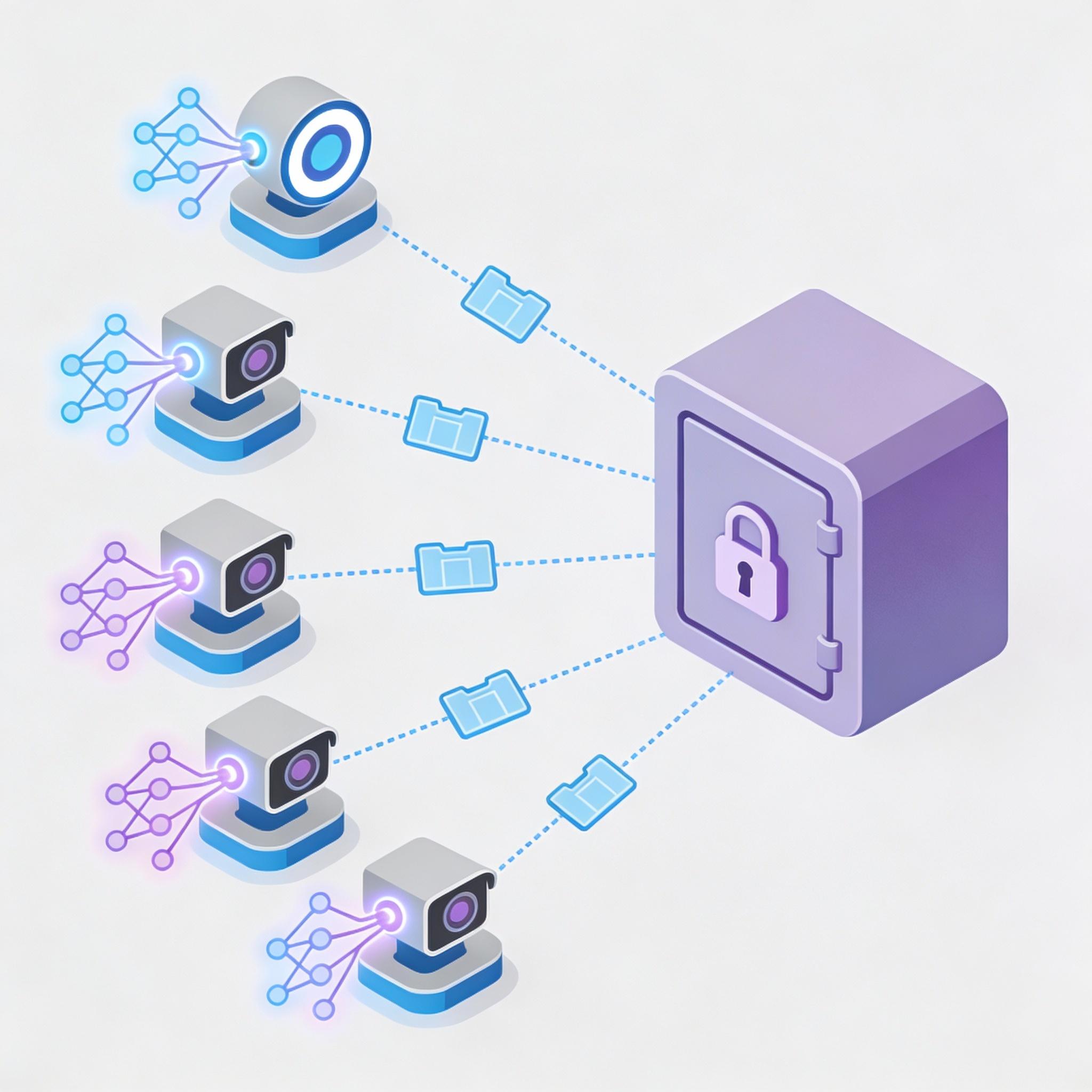
Devices locally compute model updates (gradients or weights) and send them to an aggregator that performs secure aggregation and returns improved global weights. The aggregator never sees raw telemetry.
Pros: privacy-preserving model improvement, central orchestration for model versioning. Cons: careful handling needed for poisoning and inference-leak attacks.
3. Hierarchical aggregation
Edge gateways perform secure aggregation for subsets of devices, reducing bandwidth and enabling regional adaptations before cloud-level aggregation.
Pros: reduces communication, enables policy regionalization. Cons: introduces new trusted components (gateways) that must be hardened and zero-trust verified.
Core building blocks and hardening techniques
To implement on-device AI safely, treat these building blocks as mandatory controls.
- Local anomaly engine: tiny model, quantized and sandboxed.
- Secure enclave / TPM usage: protect keys and model integrity.
- Mutual authentication: mTLS or hardware-backed attestation for every connection.
- Differential privacy and secure aggregation: prevent reconstruction of local data from updates.
- Poisoning detection: outlier-filter updates and per-device trust scoring.
- Minimal telemetry contracts: explicit schemas for what can leave the device.
A zero-trust design requires that each block be independently verifiable. For example, use signed model bundles and require attestation before accepting updates from a device.
Practical trade-offs: accuracy, privacy, and compute
- Model size vs detection capability: smaller models reduce compute cost but may miss stealthy threats. Favor compact architectures (quantized CNNs, tiny transformers, or tree ensembles) and use distillation.
- Communication budget: reduce update frequency, send only top-K updates, or sparsify gradients. Example inline JSON for a sparsified config:
{ "topK": 50, "epsilon": 1.0 }. - Privacy vs utility: stronger differential privacy (larger noise) reduces information leakage but lowers update value. Calibrate using utility tests in an isolated analytics pipeline.
Example: lightweight on-device anomaly scoring and federated update flow
Below is a minimal Python-style flow you can adapt. It’s intentionally simple to illustrate responsibilities and data flow, not meant as a production implementation.
# Local device: collect features and compute anomaly score
def collect_features(sensor_stream, window=60):
    windowed = []
    for _ in range(window):
        sample = sensor_stream.read()
        windowed.append(sample)
    return windowed

def compute_anomaly_score(features, model):
    # model is a small on-device classifier/regressor
    score = model.infer(features)
    return score

def prepare_update(model, private_key, dp_noise=0.0, top_k=None):
    update = model.export_update()
    if top_k:
        update = sparsify(update, top_k)
    if dp_noise > 0:
        update = add_dp_noise(update, dp_noise)
    signed = sign_blob(update, private_key)
    encrypted = encrypt_for_aggregator(signed)
    return encrypted

# Device sends the encrypted update to aggregator over mTLS
On the aggregator side, receive encrypted updates, perform secure aggregation, validate signatures, detect anomalous contributions, and return an aggregated model. Key defensive steps:
- Validate device attestation (device identity + boot integrity).
- Reject updates missing expected provenance.
- Run robust aggregation (trimmed mean, median-based, or Krum) to mitigate poisoning.
- Audit update sources for sudden deviation, rate-limit suspicious devices.
Defenses against common attacks
- Model poisoning: use robust aggregation and per-device reputation. Consider multi-round verification where a suspicious update is quarantined and replayed in a sandbox environment.
- Membership inference or reconstruction from model updates: apply differential privacy at device-side and only accept securely aggregated sums from multiple devices.
- Compromised aggregator: minimize leakage by using secure aggregation protocols (e.g., multi-party computation or homomorphic techniques) and split trust across validators.
Measurement and validation
Design an A/B test and simulation environment that mimics real device telemetry. Measure uplift in detection precision/recall, but also track privacy leakage metrics like advantage for membership inference under a simulated attacker.
Key metrics:
- Local detection latency (ms).
- False positive rate at device level and after aggregation.
- Contribution utility vs noise level for DP (signal-to-noise).
- Bandwidth per device per week.
Tooling and libraries (practical picks)
- On-device inference: TensorFlow Lite, PyTorch Mobile, ONNX Runtime for constrained devices.
- Secure enclaves: Intel SGX, ARM TrustZone, or Rust-based secure runtimes.
- Federated learning frameworks: TensorFlow Federated, PySyft for experimentation; lightweight custom clients for constrained devices.
- Secure aggregation: follow academic protocols or use established libraries that implement MPC or secure sum primitives.
Deployment checklist (developer-ready)
-
Device-level
- Enforce signed firmware and model bundles.
- Implement minimal anomaly model with quantized weights.
- Protect keys in hardware-backed storage or secure enclave.
- Limit outbound telemetry to schema-approved digests only.
-
Network and protocol
- Require mutual authentication (mTLS) or hardware attestation for every session.
- Encrypt updates end-to-end to the aggregator.
- Rate-limit and backoff telemetry uploads.
-
Aggregator and cloud
- Validate attestation and signatures before accepting updates.
- Implement robust aggregation (trimmed mean, median, or Krum).
- Maintain per-device trust scoring and quarantine logic.
- Log auditable events and provide forensic snapshots for suspicious updates.
-
Privacy and testing
- Integrate differential privacy at the client with tuned epsilon.
- Run membership inference tests and reconstruction attempts in your CI.
- Maintain a simulation harness that replays anonymized telemetry for model evaluation.
Summary and next steps
On-device AI combined with federated learning and zero-trust controls reduces central exposure while enabling collective threat detection for IoT fleets. The right mix of small, auditable models, hardware-backed keys, secure aggregation, and robust aggregation algorithms prevents classic attacks like poisoning and reconstruction.
Start small: deploy a lightweight anomaly detector to a pilot cohort, enable secure updates, and iterate on aggregation and privacy parameters while monitoring false positives and bandwidth. Use the checklist above as a minimum viable security baseline.
Quick checklist
- Sign and attest models before device deployment.
- Use hardware-backed keys for signing and encryption.
- Limit device telemetry to schema-approved digests.
- Apply client-side DP and sparsification to updates.
- Validate updates with robust aggregation and per-device reputation.
- Run membership and poisoning tests in CI.
On-device AI isn’t a silver bullet, but when paired with federated learning and rigorous zero-trust controls, it redefines threat detection from a centralized risk to a distributed, privacy-preserving capability. Engineers who build with these patterns gain faster detection, lower data exposure, and a resilient posture against adversaries targeting the cloud or the network.