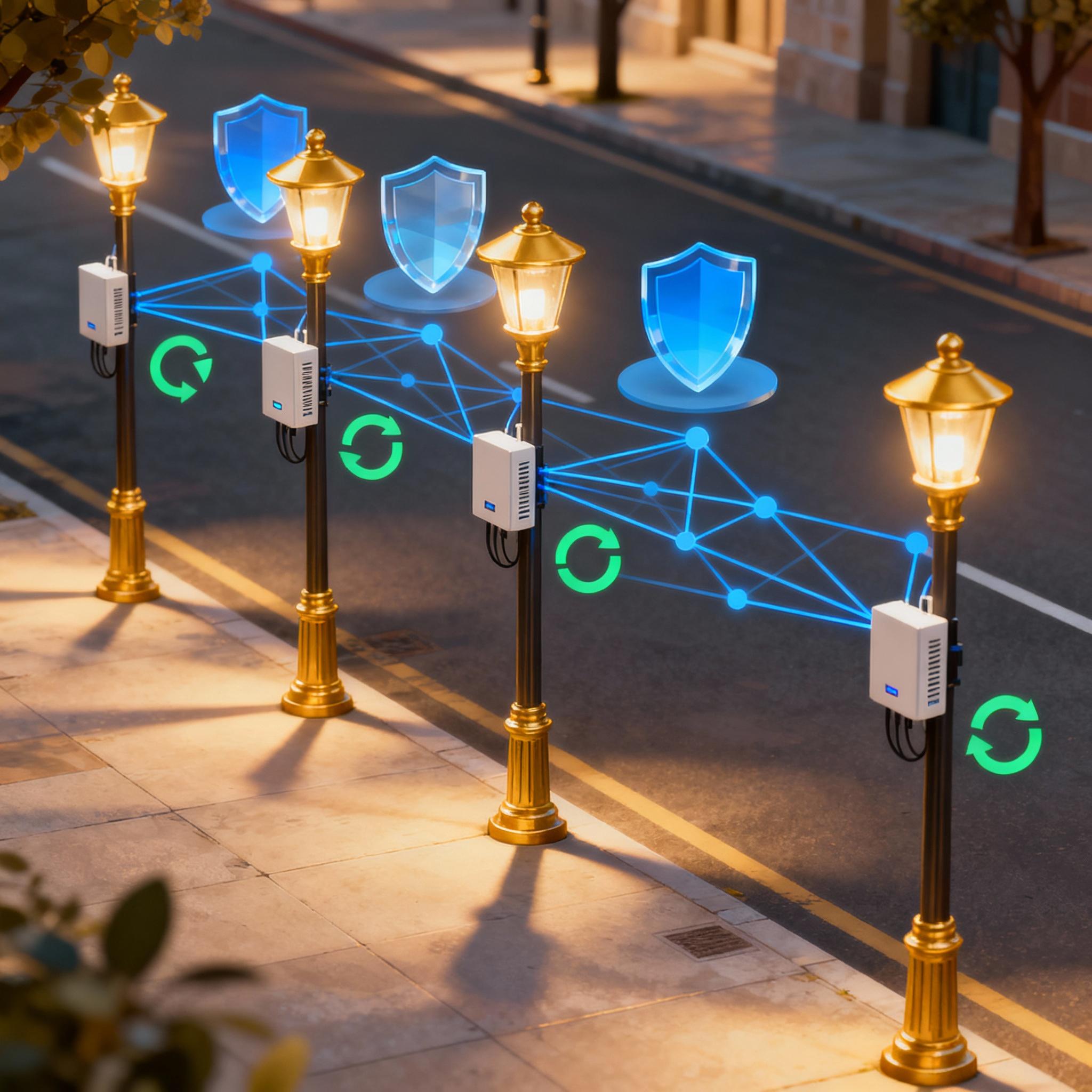
On-device Federated Learning for IoT Gateways: Privacy-Preserving, Real-Time Smart-City Analytics Without Central Cloud
Implement on-device federated learning at IoT gateways for privacy-preserving, real-time smart-city insights without sending raw data to a central cloud.
On-device Federated Learning for IoT Gateways: Privacy-Preserving, Real-Time Smart-City Analytics Without Central Cloud
Smart cities produce a torrent of sensor data. Sending all of it to a central cloud raises bandwidth, latency, cost, and privacy concerns. Instead of lifting raw data, push intelligence down: let IoT gateways train and maintain models on-device and collaborate using federated learning techniques. This post walks through an architecture and practical recipe to build privacy-preserving, real-time analytics across gateway fleets without relying on a central cloud coordinator.
Why on-device federated learning at gateways
- Privacy: raw sensor streams never leave site. Only model updates propagate.
- Real-time responsiveness: local models can make decisions with millisecond latency.
- Reduced bandwidth: model deltas are orders of magnitude smaller than raw video/audio streams.
- Resilience: operations continue when connectivity to a central cloud is unavailable or constrained.
Gateways sit between sensors and the wider network and usually have modest CPU, memory, and intermittent connectivity. That constraint shapes the design: small models, incremental training, compressed communications, and low-overhead secure aggregation.
Architecture overview
Components
- Device sensors: cameras, air quality, traffic counters.
- Gateway node: ARM or x86 with limited GPU/TPU availability, runs a local model and FL stack.
- Peer network: mesh or regional peers for aggregator roles.
- Optional regional aggregator: a trusted aggregator that may be another gateway or a local server; no central cloud required.
Topology Patterns
- Hierarchical: sensors → gateway local aggregation → regional aggregator → federation among aggregators. This reduces cross-gateway traffic.
- Fully decentralized (gossip): gateways exchange model deltas peer-to-peer and converge via averaging. This avoids any single point of coordination.
- Hybrid: periodic regional syncs combined with continuous local updates.
Choose topology based on connectivity, trust model, and latency goals.
Algorithms and constraints
- Use light federated algorithms: FedAvg or FedProx variants adapted to asynchronous updates.
- Prioritize smaller models: MobileNet, tiny transformers, or even linear models for anomaly detection.
- Enable quantization and sparsification: communicate only top-k gradients or use 8-bit quantization.
- Tolerate staleness: asynchronous aggregation with bounded staleness improves robustness to intermittent nodes.
When discussing comparisons, remember to escape greater-than signs: use > where needed in documentation. For example, prefer models with parameter counts < 5M for typical gateway hardware.
Privacy and security
- Secure aggregation: apply secure aggregation so peers cannot inspect individual updates. Implement cryptographic masking or use multi-party aggregation protocols.
- Differential privacy: add calibrated noise at gateways before sharing updates. Tune epsilon to balance privacy and utility.
- Attestation and trust: use TPM or secure enclave attestation to verify gateway software integrity.
- Authentication: mTLS or mutual TLS for peer-to-peer channels.
Combining secure aggregation and differential privacy prevents model inversion attacks and preserves citizen data privacy.
Communication efficiency
- Compress updates: use Top-K, quantization, or sketching.
- Frequency control: train locally for N steps, then publish updates. Choose N to balance freshness and bandwidth.
- Gossip protocols: random peer selection and partial averaging reduce peak traffic compared to all-to-all synchronization.
Keep in mind that a single synchronizing round across 1000 gateways can be expensive. Use hierarchical or partial aggregation.
Practical design: a minimal on-device FL loop
Below is a compact pseudocode example that implements local training and a gossip-style aggregation step. The code focuses on clarity and is suitable as a starting point for productionizing with proper networking and crypto.
# minimal gateway federated loop
initialize local_model
connect to peer_discovery_service
while True:
    # collect and preprocess a batch from local sensors
    batch = collect_local_batch()
    # local training step
    loss = train_step(local_model, batch)
    # accumulate update every K steps
    if local_step % K == 0:
        update = extract_model_delta(local_model, global_snapshot)
        compressed = compress_update(update, method='topk', k=1000)
        # publish to a small set of peers
        peers = select_random_peers(num=3)
        for p in peers:
            send_update(p, compressed)
        # receive updates, decompress, and apply an average
        incoming = receive_updates(timeout=2)
        if incoming:
            aggregated = weighted_average([decompress(u) for u in incoming] + [update])
            apply_delta(local_model, aggregated)
    local_step += 1
Notes on this loop:
global_snapshotcan be a local copy of the last-known global model to compute deltas.compress_updateuses sparsification or quantization to limit payloads.- The gateway acts as both client and partial aggregator in gossip mode.
- Proper production code replaces
send_update/receive_updateswith authenticated RPC and secure aggregation.
Model partitioning and heterogeneity
Gateways vary in capability. Use model partitioning:
- Split models into a tiny on-device core and an optional heavier head that only runs on more capable nodes.
- Use knowledge distillation to transfer improvements from powerful gateways to constrained ones.
This allows you to run a baseline model universally and augment functionality where possible.
Deployment and lifecycle
- Continuous deployment: deliver small model updates via signed artifacts and support rollback.
- Monitoring: track model drift metrics, data distribution skew, and system metrics like CPU, memory, and latency.
- Training validation: designate a small set of gateways to evaluate candidate aggregations before fleet-wide rollout.
Automated A/B rollout at the gateway level helps detect regressions early without impacting the entire city.
Failure modes and mitigation
- Stragglers: rely on asynchronous updates and bounded staleness rather than waiting for every gateway.
- Poisoning: implement anomaly detection on updates and require attestations for critical aggregations.
- Network partitions: use opportunistic syncing and local fallbacks where decisions are made by local models.
Example configuration snippet
A compact, escape-ready config for a gateway FL agent might look like this in inline JSON. Wrap JSON in backticks and escape curly braces as shown.
{ "sync_interval": 300, "top_k": 1000, "secure_aggregation": true, "peer_count": 3 }
This shows the minimal knobs: sync interval in seconds, sparsification bucket size, whether to use secure aggregation, and the number of peers to contact per round.
Summary and checklist
- Design constraints: choose models < 5M parameters for typical gateways and use quantization.
- Topology: prefer hierarchical or gossip to avoid a central cloud bottleneck.
- Privacy: pair secure aggregation with differential privacy to protect citizens.
- Efficiency: compress updates, batch local training steps, and control sync frequency.
- Robustness: support asynchronous updates, attestation, and anomaly detection on updates.
Checklist for implementation
- Choose a base model (MobileNet/Lightweight transformer/linear) and verify memory footprint.
- Implement local training loop and delta extraction.
- Add compression (top-k or quantization) for updates.
- Integrate secure aggregation or masking protocol.
- Build peer discovery and gossip or hierarchical aggregation.
- Add monitoring, attestation, and rollback paths.
On-device federated learning at the gateway layer is feasible today. With careful model selection, communication optimization, and privacy-first design, cities can gain real-time analytics and automation without exposing raw sensor streams to a central cloud. Start small, validate on a regional cluster of gateways, and iterate on aggregation and privacy parameters as utility and risk profiles become clearer.