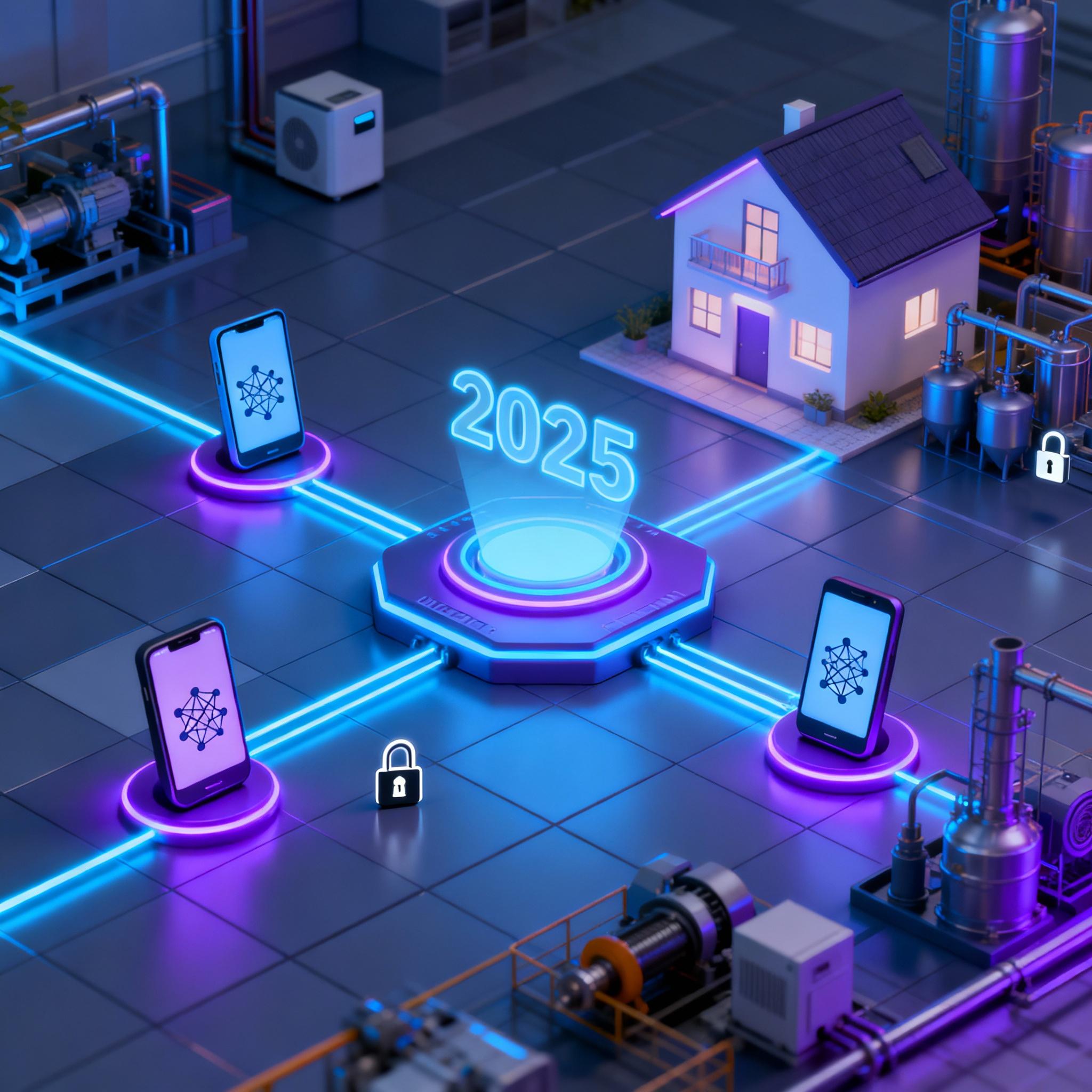
On-device Federated Learning for IoT: Privacy-preserving edge AI for smart homes and industrial IoT in 2025
Practical guide to on-device federated learning for IoT in 2025: architectures, challenges, secure aggregation, model compression, and a deployable example.
On-device Federated Learning for IoT: Privacy-preserving edge AI for smart homes and industrial IoT in 2025
On-device federated learning (FL) is no longer an academic novelty — by 2025 it’s a practical architecture for privacy-sensitive IoT systems in smart homes and industrial settings. Developers and engineers building edge AI must balance limited compute, intermittent connectivity, and adversarial risk, while delivering models that improve from distributed, non-IID data without moving raw data off devices.
This post is a practical, implementation-focused guide. You will get a concise overview of architectures that work in production, the hard constraints you must design for, techniques to reduce communication and compute costs, and a small, deployable on-device training pattern you can adapt for thermostats, vibration sensors, cameras, or gateways.
What is on-device federated learning (FL)?
In on-device FL, devices keep raw data locally and exchange model updates with a coordinating server or aggregator. Common patterns:
- Device-to-server: devices compute updates locally and upload gradients or weights; server aggregates and returns a new global model.
- Hierarchical: local gateways aggregate subsets of devices, then gateways communicate with a central server — useful for industrial plant floors.
- Peer-to-peer: devices exchange updates without a central server; rare in production due to complexity.
Benefits for IoT:
- Privacy: raw sensor streams never leave the device.
- Bandwidth: uploading compact model deltas instead of high-frequency telemetry saves bandwidth.
- Personalization: models can adapt to local device patterns while contributing to a global model.
Key IoT challenges and how they change your design
Heterogeneous hardware and compute
IoT devices range from 32-bit microcontrollers to Raspberry Pi class gateways. Designs that assume uniform compute will fail. Use modular model families with tiny, small, and gateway-sized variants, and implement server-driven model selection.
Intermittent connectivity and device churn
Devices may be offline or power-cycled. Plan for partial participation: training logic should checkpoint local progress and be robust to missed rounds.
Non-IID data and skew
Sensor distributions vary by location and usage. Expect model divergence; use federated optimization strategies that tolerate heterogeneity (FedProx, personalized layers).
Energy and thermal constraints
On-device training consumes power. Throttle CPU/GPU use and schedule training during charging windows or low-activity periods.
Practical FL architectures for IoT
Centralized federated averaging
The canonical pattern: clients train locally, send model deltas, server performs weighted averaging (Federated Averaging). Simple and well-supported by mature frameworks.
When to use: fleets of constrained devices whose updates can be batched and where a trusted aggregator exists.
Hierarchical aggregation
Edge gateways aggregate the updates of nearby sensors and forward summarized updates upstream. This reduces communication cost and supports local personalization.
When to use: industrial settings with reliable local networks but constrained uplinks, or when regulatory zones require local aggregation.
Split learning and server-assisted training
Split learning keeps some model layers on-device and others on the server. Use when device memory is too small for the full model but privacy constraints prevent raw data transfer.
When to use: camera-based analytics where raw frames must never leave the device.
Model design and compression techniques
To fit training on devices and shrink communication payloads, combine these techniques:
- Small architectures: design tiny models (MobileNetV2-lite, small RNNs) or use domain-specific feature extractors.
- Quantization-aware training and post-training quantization to int8 or float16.
- Pruning and sparse updates: send only top-k weight changes.
- Sketching and delta compression: use difference encoding and entropy coding.
- Knowledge distillation: train a compact student model on-device using teacher-provided soft-labels or distilled signals.
Combine techniques: quantized sparse deltas often give the best bandwidth/accuracy tradeoff.
Privacy, security, and robustness
Privacy mechanisms for FL in IoT include:
- Differential privacy (DP): add calibrated noise to updates. Use local DP carefully — it degrades accuracy and must be balanced with aggregation.
- Secure aggregation: cryptographic protocols that allow the server to aggregate updates without seeing individual contributions.
- Trusted Execution Environments (TEE): perform sensitive operations inside hardware enclaves when available.
Robustness against poisoning and Byzantine clients:
- Use robust aggregation (trimmed mean, median, Krum).
- Monitor update statistics and maintain reputation scores for devices.
- Implement server-side validation and rollback mechanisms.
Operational tip: combine secure aggregation and DP at the right layer. Secure aggregation protects raw updates; DP provides formal statistical guarantees for outputs.
Example: lightweight on-device training loop for a thermostat
The pattern below is intentionally small: local training, checkpoint, compute delta, compress, and upload. Use it as a template — replace optimizer and data loader to fit your device SDK.
def local_train(model, data_loader, epochs, optimizer):
    model.train()
    for _ in range(epochs):
        for x, y in data_loader:
            pred = model(x)
            loss = loss_fn(pred, y)
            loss.backward()
            optimizer.step()
            optimizer.zero_grad()
    return model

def compute_delta(global_model, local_model):
    deltas = []
    for g_param, l_param in zip(global_model.parameters(), local_model.parameters()):
        deltas.append(l_param.data - g_param.data)
    return deltas

def compress_deltas(deltas, mode='topk', k=100):
    # implement top-k sparsification and quantize to int8 before upload
    return compressed_payload

# Client runtime
if has_new_local_data():
    local_model = load_checkpoint_or(global_model)
    train_data = load_recent_windows()
    local_model = local_train(local_model, train_data, epochs=1, optimizer=opt)
    deltas = compute_delta(global_model, local_model)
    payload = compress_deltas(deltas)
    upload_to_aggregator(payload)
    save_checkpoint(local_model)
On the server side, aggregation is typically a weighted average where each client’s update is weighted by number of local examples. The server should validate payloads, decrypt or decompress, and apply robust aggregation.
Frameworks and tooling in 2025
Mature libraries and tools you should evaluate:
- TensorFlow Lite and TF Lite Micro for inference and limited on-device training.
- PyTorch Mobile and TorchScript for slightly larger edge devices.
- Flower and FATE for orchestration of FL experiments and deployments.
- Open-source secure aggregation libraries and DP toolkits integrated into frameworks.
Operational tooling: over-the-air (OTA) update systems, device provisioning and attestation, monitoring dashboards that report round participation, update sizes, training loss trends, and device health.
Deployment considerations and testing
- Simulation first: run FL with recorded device traces to estimate convergence and bandwidth.
- Canary rolls: start with a subset of devices and measure accuracy drift and resource impact.
- Monitoring: track client participation, mean update size, per-round accuracy, and detection of anomalous updates.
- Fallback: if on-device training fails or causes regressions, have a mechanism to disable it remotely and provide a safe default model.
Summary and quick checklist
On-device FL can deliver privacy-preserving, adaptive models for smart homes and industrial IoT — but it changes the way you design models, pipelines, and ops.
Checklist before you ship:
- Define constraints: CPU, memory, energy, and expected connectivity windows.
- Choose an architecture: centralized FedAvg, hierarchical, or split learning.
- Design model families: tiny device models and gateway models.
- Implement compression: quantization, pruning or top-k sparsification.
- Add privacy and security: secure aggregation, DP, TEEs when available.
- Build robust ops: checkpointing, canarying, monitoring, and rollback.
- Test with realistic traces and non-IID data.
On-device federated learning is a trade-off: you trade central visibility for privacy and bandwidth efficiency. With the right tooling and conservative operational controls, FL unlocks continuous improvement without lifting sensitive raw data off devices.
Start small, iterate on model and participation strategies, and design for graceful failure. In 2025, that approach is what separates proof-of-concept FL from a production-grade, privacy-preserving edge AI system.