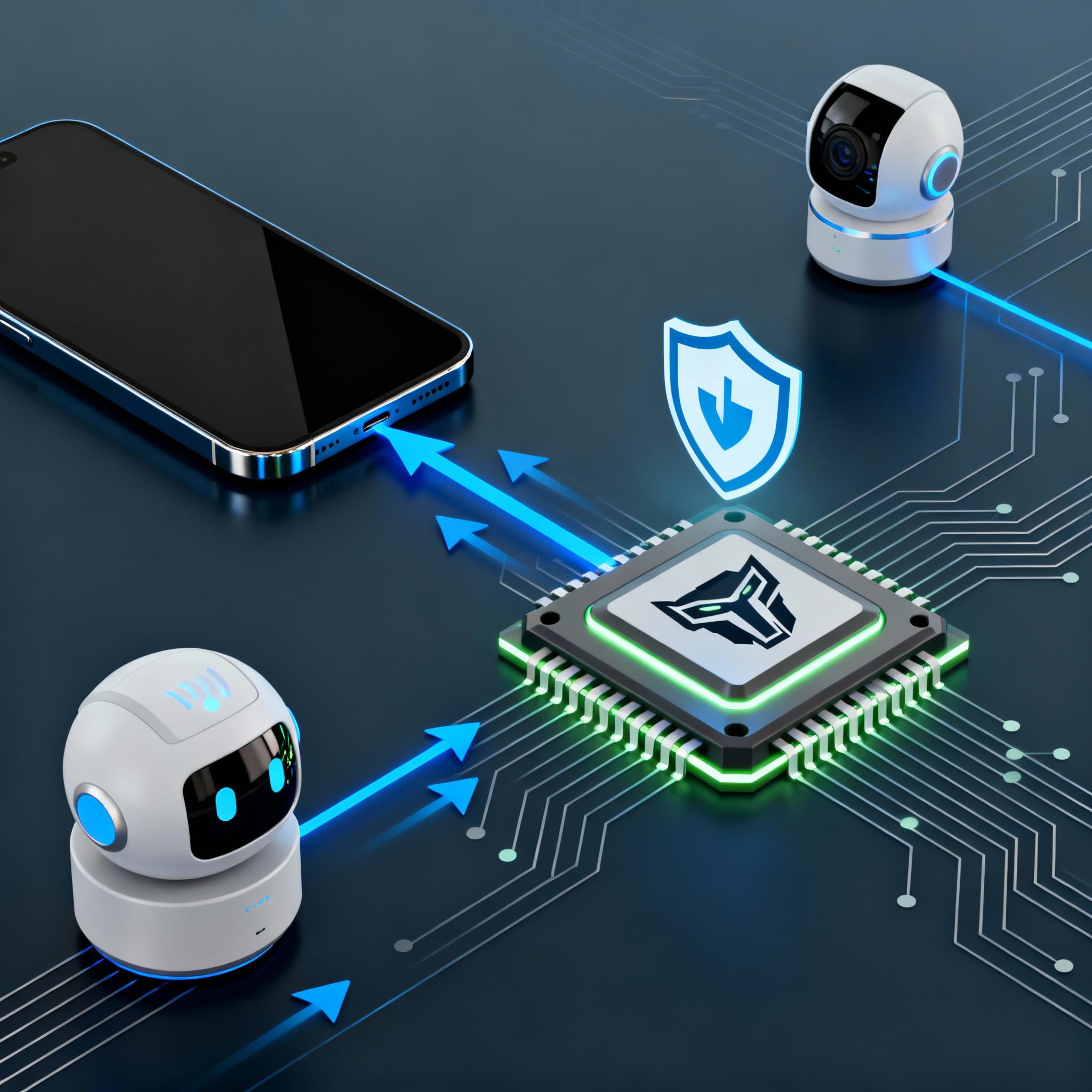
On-Device Transformers: How Edge AI Is Rewriting Privacy, Latency, and Energy Efficiency for Smartphones and IoT Edge Devices
Practical guide to running transformer models on-device: techniques, trade-offs, and engineering patterns to optimize privacy, latency, and power on smartphones and IoT.
On-Device Transformers: How Edge AI Is Rewriting Privacy, Latency, and Energy Efficiency for Smartphones and IoT Edge Devices
Introduction
Transformers rewrote NLP and are now pushing into vision, audio, and multimodal applications. Historically, these large models ran in the cloud — fast GPUs, abundant memory, and easy updates. But shifting inference to the edge (smartphones, microcontrollers, cameras) yields three tangible wins developers care about: stronger privacy guarantees, lower latency, and reduced network energy costs.
This article is a practical engineer’s guide. You’ll get the architectural patterns, optimization techniques, deployment targets (TFLite, ONNX, Core ML), and a hands-on code example to move a transformer from the cloud to a constrained device. No marketing fluff — just tactics you can use in production.
Why run transformers on-device?
Privacy
On-device inference keeps raw data local. Sensitive inputs (audio, photos, typed text) never leave the device, greatly reducing risk surface and simplifying compliance. For many products, that privacy benefit alone is the deciding factor.
Latency
Edge inference removes network round-trips. Expect deterministic latency that is often an order of magnitude lower than cloud calls for small models and interactive tasks. For user-facing features (predictive text, camera auto-labeling), latency directly maps to perceived quality.
Energy and Cost
Cloud inference can be energy-efficient per-inference at massive scale, but transferring data and paying per-call quickly adds up. Efficient on-device models reduce cloud costs and avoid energy spent on radios — especially important for battery-powered IoT devices.
Constraints to accept and optimize around
- Memory: RAM is limited; models must fit both weights and activation buffers.
- Compute: CPU cores, mobile GPUs, or NPUs have different throughput characteristics.
- Power: Thermal limits throttle sustained performance; peak turbo isn’t sustainable.
- Storage: Model size affects app footprint and OTA update strategy.
Accept these constraints. Optimization is about trading off accuracy for size and latency in ways that align with product specifications.
End-to-end architecture patterns
Small model, small server: on-device primary + cloud backup
Run a compact transformer on-device for real-time UX. Offload to cloud for long-tail, high-quality results or training. This hybrid pattern preserves privacy for most cases and leverages cloud only when necessary.
On-device cascade
Use a tiny classifier to decide whether to run a larger model locally or invoke cloud. Cascading prevents wasteful inference and saves energy.
Split execution (model partitioning)
Split the model: front layers on device, back layers on cloud. This can reduce data transfer but requires secure, low-latency links and careful memory planning. Rarely the best choice unless device compute is strictly insufficient.
Optimization techniques that matter
Model architecture choices
Pick a model built for efficiency: DistilBERT, MobileBERT, TinyBERT, Longformer/Perceiver variants, or sparse/linear attention models like Performer. Smaller token dimensions and fewer layers reduce memory and compute.
Quantization
Quantization reduces model size and accelerates integer-friendly accelerators. Options:
- Dynamic-range quantization: minimal accuracy loss, easy to apply.
- Full integer (post-training) quantization: requires representative data for activations.
- Quantization-aware training (QAT): highest accuracy for low-bit quantization.
On mobile hardware, 8-bit integer inference is often the best cost/benefit point. Some NPUs support 16-bit floating point (FP16) efficiently; choose based on available hardware.
Pruning and sparsity
Structured pruning (removing attention heads or entire channels) gives predictable speedups and smaller memory. Unstructured sparsity can shrink weights but needs hardware or runtime support to realize speed gains.
Knowledge distillation
Distill a large teacher model into a lightweight student. Distillation pairs well with quantization: distill first, quantize second.
Operator fusion and compiler stacks
Use vendor toolchains: Android NNAPI, Apple Core ML, or ONNX Runtime with mobile delegates. Compiler optimizations and fused kernels reduce memory copies and latency.
Deployment targets and runtimes
- TensorFlow Lite: well-supported on Android and iOS, good tooling for quantization and delegates.
- ONNX Runtime Mobile: flexible, supports many backends, good for cross-framework pipelines.
- Core ML: first-class on Apple hardware, can convert TFLite/ONNX models.
- Custom runtimes: sometimes necessary for microcontrollers (TensorFlow Lite Micro).
Pick the runtime that gives you the best access to the device accelerators (NPU, GPU). Delegates often provide the biggest practical speedups.
Profiling and measurement
Measure before you optimize. Useful tools:
- Android Profiler, Perfetto for system traces.
- Instruments and Console on macOS/iOS.
- powertop and simple energy monitors for Linux-based IoT.
- ONNX Runtime profiling APIs or TFLite’s benchmarking tools.
Capture end-to-end metrics: cold-start model load time, latency P50/P95, peak memory, and energy per inference. Optimize for the metric that maps to user experience.
Practical example: convert a HuggingFace model to a quantized ONNX for mobile inference
Below is a minimal pipeline: export a PyTorch transformer to ONNX, apply dynamic quantization, and run inference with ONNX Runtime (mobile-friendly). This is a starting point — production pipelines require representative data, validation, and A/B testing.
# export PyTorch to ONNX
python -c "from transformers import AutoModel, AutoTokenizer; import torch
model = AutoModel.from_pretrained('distilbert-base-uncased')
tokenizer = AutoTokenizer.from_pretrained('distilbert-base-uncased')
inputs = tokenizer('Edge inference test', return_tensors='pt')
torch.onnx.export(model, (inputs['input_ids'],), 'distilbert.onnx', opset_version=13, input_names=['input_ids'], output_names=['last_hidden_state'], dynamic_axes={'input_ids':[0,1],'last_hidden_state':[0,1]})"

# quantize ONNX (dynamic range)
python -c "from onnxruntime.quantization import quantize_dynamic, QuantType; quantize_dynamic('distilbert.onnx', 'distilbert.quant.onnx', weight_type=QuantType.QInt8)"

# run inference with ONNX Runtime (CPU) - simple benchmark
python -c "import onnxruntime as ort, numpy as np
sess = ort.InferenceSession('distilbert.quant.onnx')
input_ids = np.array([[101, 7592, 0]])  # example token ids
outputs = sess.run(None, {'input_ids': input_ids})
print(outputs[0].shape)"
Notes:
- The ONNX export often needs shape/dtype tuning depending on the model. Use
dynamic_axesfor batching. - For device deployment, bundle the quantized model and choose an inference runtime that maps to the device accelerator.
- If using TFLite, follow a similar flow: convert to SavedModel, then TFLite with representative dataset for full-int quantization.
Engineering trade-offs and best practices
- Start with a product-level SLA (latency P95, acceptable accuracy delta, memory budget). Optimize to that SLA, not arbitrary model size.
- Use a small validation harness that mirrors device behavior. Differences between desktop and mobile runtimes can be subtle.
- Prefer post-training quantization to validate feasibility quickly; switch to QAT for production parity when needed.
- Minimize startup cost: load lighter model first, lazy-load heavy components, or use memory-mapped models to reduce peak RAM.
- Monitor in-field metrics: thermal throttling can change observed latencies over time and across OS versions.
Summary and checklist
Checklist before shipping an on-device transformer feature:
- Define SLOs: target latency (P50/P95), memory budget, and maximum accuracy drop.
- Select an efficient architecture (DistilBERT, MobileBERT, TinyBERT, or linear-attention variant).
- Apply a quantization strategy: dynamic → full integer → QAT as needed.
- Use representative data for calibration when required by quantization.
- Choose runtime & delegate that maps to target hardware (NNAPI, Core ML, GPU/NPU delegate).
- Profile end-to-end: cold/start load, inference P50/P95, memory, and energy.
- Implement fallback/hybrid paths: on-device primary + cloud backup or cascade.
- Build monitoring to detect thermal throttling, drift in model outputs, and increased latency in the field.
On-device transformers are not a magic bullet, but with the right techniques they deliver meaningful gains in privacy, latency, and energy — and they enable new UX paradigms that cloud-only systems cannot. Start small, measure, and iterate.