Optimizing Small LLMs for On-Device Inference: Overcoming Memory and Latency Bottlenecks on Edge Hardware
Practical techniques to run small LLMs on edge devices: quantization, memory layout, kernel optimizations, and runtime tricks to cut memory and latency.
Optimizing Small LLMs for On-Device Inference: Overcoming Memory and Latency Bottlenecks on Edge Hardware
Running small large language models (LLMs) on mobile phones, micro-PCs, or embedded devices forces you to confront memory and latency constraints head-on. Cloud inference hides these problems with abundant RAM and specialized accelerators; edge hardware doesn’t. This post gives a practical, engineer-focused playbook: concrete techniques you can apply to reduce memory footprint, improve throughput, and shave milliseconds off latency while preserving acceptable accuracy.
Why on-device LLMs are different
Edge hardware imposes three hard limits: RAM, peak compute, and thermal/power budget. Those limits create trade-offs you must explicitly manage:
- Memory wins: if model + runtime can’t fit in RAM, nothing else matters.
- Latency is dominated by memory movement: cache misses, DRAM fetches, and CPU/GPU-to-accelerator transfers often cost more than raw FLOPS.
- Power caps can throttle clocks, making worst-case latency vary widely.
Optimizing for these constraints requires a mix of model-level techniques and low-level engineering.
Choose the right model and architecture
Start here before you optimize kernels. Small LLMs come in flavors: distilled transformer, lightweight transformer variants, and locally trained models with fewer parameters. Choices matter:
- Favor smaller embedding sizes and fewer heads over larger hidden dims when memory is tighter than compute.
- Use weight-sharing (ALBERT-style) or parameter-efficient blocks if you can tolerate slightly more complexity in training.
- Prefer causal decoders optimized for incremental decoding over encoder-decoder stacks for chatty, interactive workloads.
Remember: a smaller model that fits and runs fast on-device is better than a larger, more accurate model that thrashes memory.
Quantization strategies: where to cut precision
Quantization gives the best bang-for-buck in memory reduction and bandwidth savings. Key patterns:
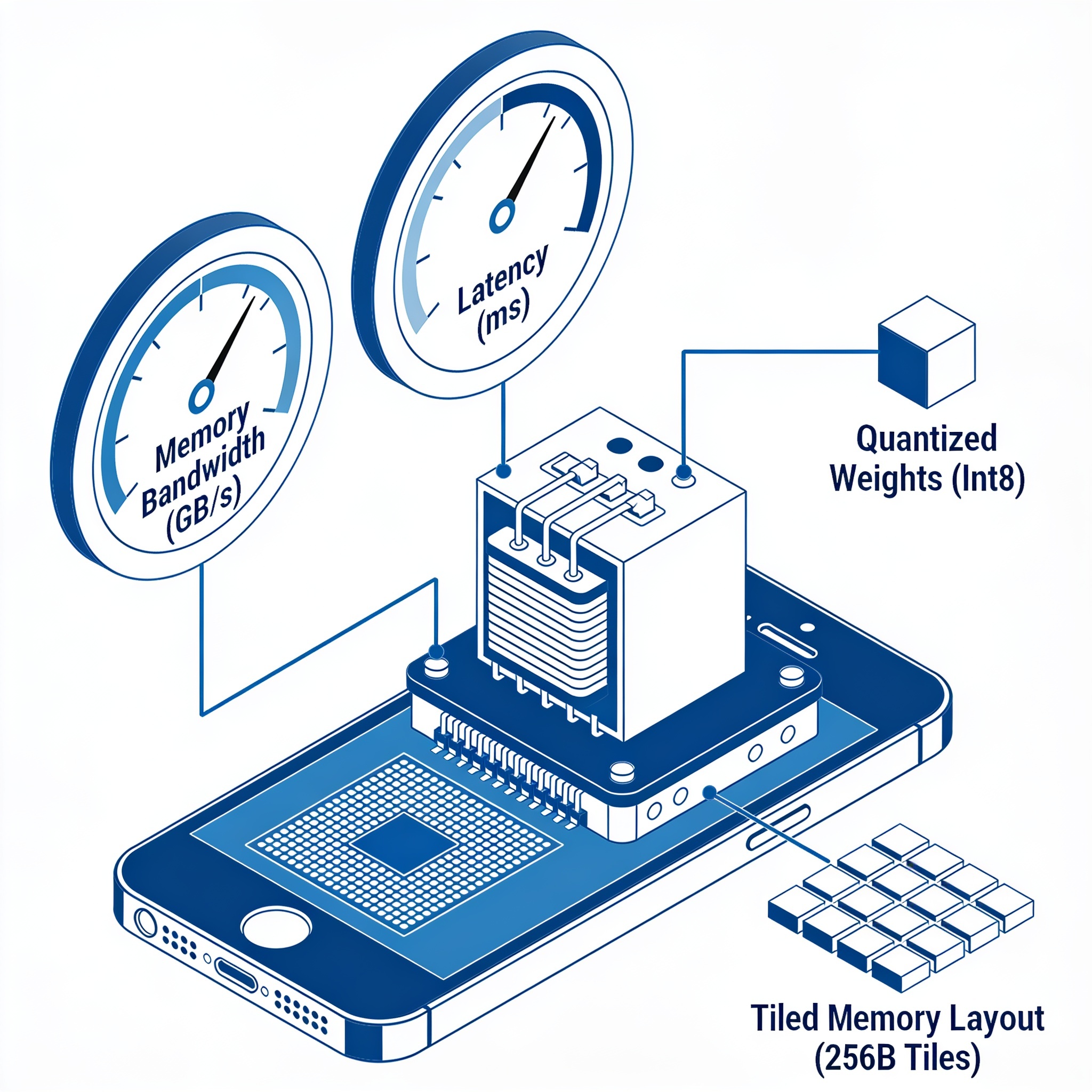
- Start with static post-training quantization (PTQ) to int8 for weights; activations can be per-layer or per-channel scales.
- Use asymmetric quantization only for activations if collector overhead for dynamic ranges is manageable.
- If PTQ introduces unacceptable accuracy loss, try quantization-aware training (QAT) or mixed-precision: keep embedding and layernorm in float32 or float16, quantize large Fully Connected (FC) matrices.
- Explore 4-bit (int4) or groupwise quantization for extreme memory savings, but measure carefully — some tasks are fragile to low-bit quant.
Practical rule: quantize the largest matrices first (usually projection/FFN weights). That yields the highest memory and bandwidth wins.
Memory layout and streaming: control data movement
Memory layout is as important as precision. Poor layout forces cache-unfriendly access patterns and repeated DRAM reads.
- Use row-major or column-major layout consistent with your GEMM kernel to avoid runtime transposition.
- Store quantized weights in interleaved tiles matching the micro-kernel tile size (for example, 8x32 tiles). That lets you load contiguous blocks into vector registers.
- Stream weights from flash/secondary storage lazily if RAM can’t hold the full model. Load layer weights just-in-time and free them immediately after the layer is computed.
- Keep hot small buffers (embedding table cache, last KV cache entries) in the highest cache-friendly memory region.
Streaming example: when running 1-2 token at a time for chat, load only the next transformer’s layer weights and cache previous activations needed for attention.
Kernel and microarchitecture optimizations
Optimizing kernels often delivers the biggest latency wins once quantization and layout are done.
- Use handcrafted micro-kernels (NEON/AVX2/AVX512) or library-provided optimized GEMMs tuned to tile sizes matching your layout.
- Fuse layer operations where possible: fused GEMM + bias + activation avoids extra memory writes/reads.
- Implement int8 GEMM with accumulation into int32 followed by requantize to float if needed. Use vectorized reduction to compute scales quickly.
- Avoid unnecessary memory fences and use prefetch instructions if your platform supports them.
Small change, huge effect: replacing a generic GEMM with a tiled, vectorized micro-kernel that matches your quantized layout often cuts latency by 30–60%.
Batching, caching, and scheduling
Batching reduces per-token overhead but increases peak memory. For interactive apps, prioritize latency over max throughput.
- Dynamic micro-batching: group incoming requests for a very short window (1–10 ms) to increase utilization without adding visible delay.
- Cache KV pairs for autoregressive decoding. If the model supports incremental attention, store quantized KV caches and only dequantize when necessary.
- Use asynchronous scheduling: overlap input preprocessing and tokenization with model weight loading and the preceding layer’s compute.
Trade-offs: batching helps throughput at the cost of higher memory; KV caching saves compute but uses memory. Pick the combination that matches your device constraints.
Distillation and structured pruning
If quantization and kernel work still leave you short, reduce model size via training techniques:
- Distillation: train a smaller student model on the teacher’s outputs. Students usually retain most of the teacher’s performance with far fewer parameters.
- Structured pruning: remove attention heads or entire MLP blocks and fine-tune. Structured pruning yields runtime gains because it reduces matrix sizes, not just sparsity in storage.
- Progressive layer dropping: in some cases, you can dynamically skip layers for easy inputs to reduce average latency.
Combine distillation with quantization for multiplicative gains.
Profiling and debugging: find the real bottlenecks
Don’t optimize blind. Use platform profilers and lightweight timers.
- Measure end-to-end latency and break it down: tokenization, embedding lookup, per-layer compute, memory copies, I/O.
- Track cache-miss rates and DRAM bandwidth. If bandwidth is saturated, further FLOPS optimizations won’t help.
- Compare peak memory (RSS) vs. committed allocation vs. transient peak. Streaming approaches reduce committed peak.
Collect representative traces: interactive typing patterns are very different from throughput benchmarks.
Example: simple int8 inference loop
Below is a minimal, illustrative inference loop showing how to perform an int8 matrix-vector multiply with per-channel scale dequantization and an activation fused. This is intentionally simple; real kernels need blocking and vectorization.
def int8_gemv(qW, scales, zps, x):
    # qW: list of rows, each row is list of int8 values (integers -128..127)
    # scales: list of float scale per row
    # zps: zero-point (int) or list per-row
    # x: input float vector
    y = [0.0] * len(qW)
    for i in range(len(qW)):
        acc = 0
        row = qW[i]
        zp = zps[i] if isinstance(zps, list) else zps
        for j in range(len(row)):
            acc += (row[j] - zp) * x[j]
        # dequantize and scale
        y[i] = acc * scales[i]
    return y
This example omits tiling, accumulation into int32, and vectorized instructions — but it shows the sequence: load quantized weights, subtract zero-point, accumulate, apply per-channel scale, and fuse activation where possible.
Practical checklist before shipping
- Model selection: Choose an appropriately sized architecture (embedding dims, heads, layers).
- Quantization: Apply PTQ int8; fall back to mixed precision or QAT for problematic layers.
- Layout: Tile and interleave weights to match micro-kernel requirements.
- Kernels: Use or implement vectorized, fused micro-kernels that avoid extra memory writes.
- Memory: Stream weights when necessary, and ensure KV cache and embeddings are in fast memory.
- Runtime: Implement micro-batching, asynchronous scheduling, and early-exit for easy inputs.
- Profiling: Measure memory bandwidth, cache behavior, and per-layer latency on real devices.
- Validation: Test quality regressions across representative workloads, not just synthetic benchmarks.
Summary
Getting small LLMs to run well on edge hardware requires focused effort at multiple layers: pick a compact model, quantize judiciously, optimize memory layout, use fused kernels, and tune runtime scheduling. The biggest wins usually come from quantization plus matched layout + micro-kernel optimization — those reduce both memory footprint and the amount of data shuttled between memory and compute. Measure early, profile constantly, and prioritize reproducible gains over theoretical improvements.
Checklist (copyable):
- Confirm model fits RAM (with KV cache) or implement streaming.
- Quantize largest matrices first, evaluate accuracy.
- Align weight layout to kernel tile size.
- Replace generic GEMMs with fused, vectorized micro-kernels.
- Implement KV caching and micro-batching policies tuned to latency targets.
- Validate on target hardware under worst-case thermal/power conditions.
Optimizing for edge is an engineering trade-off exercise. Apply the techniques above iteratively: measure, change one variable, and measure again.