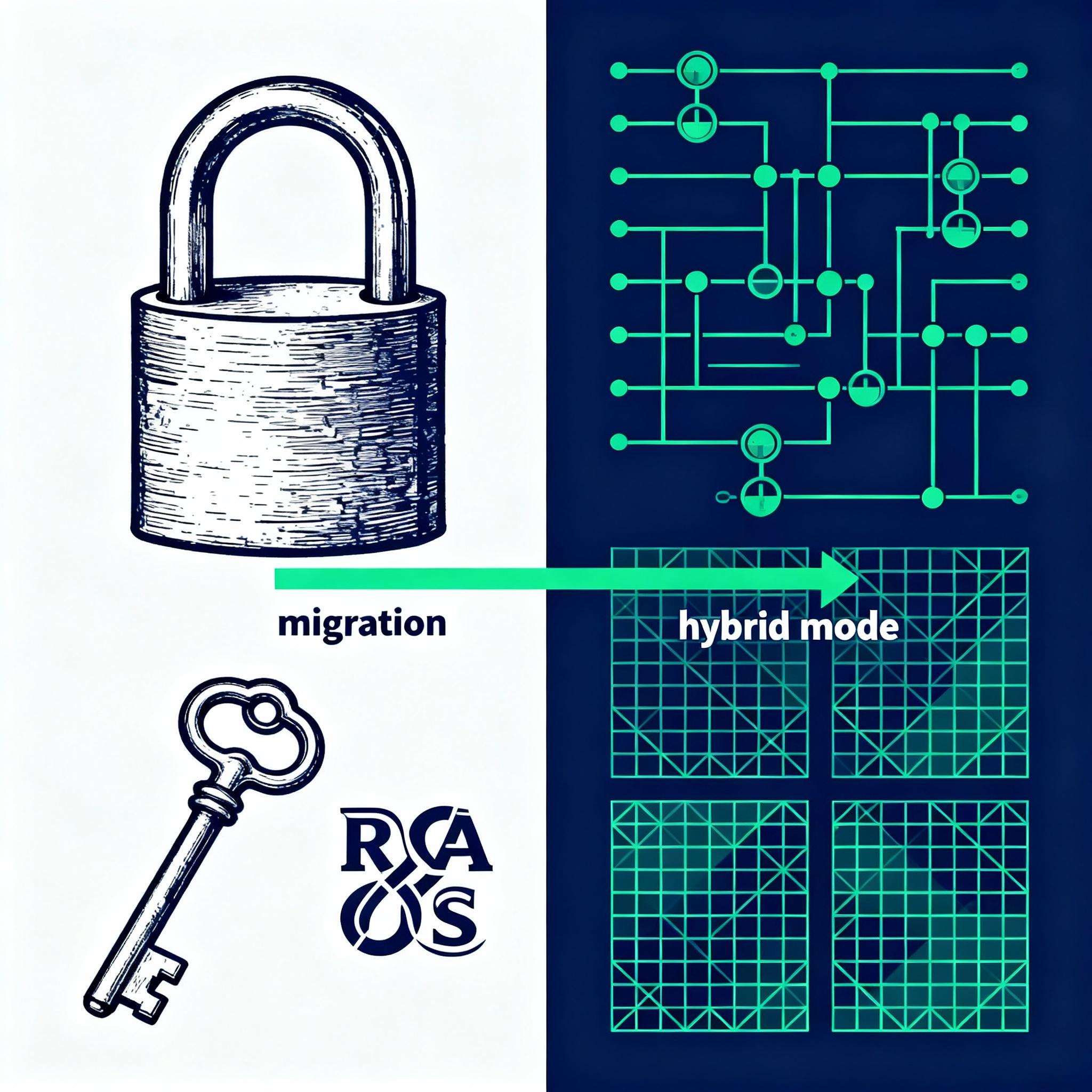
Post-Quantum Migration Playbook: Transitioning to Quantum-Resistant Cryptography (2025)
Practical, step-by-step playbook for engineering teams to migrate to post-quantum cryptography in 2025.
Post-Quantum Migration Playbook: Transitioning to Quantum-Resistant Cryptography (2025)
Quantum computers are no longer theoretical for long-term security planning. Advances in hardware, improved error correction, and active research mean organizations must act now to avoid a future where today’s public-key algorithms are harvestable and decryptable. This playbook gives engineers and technical leaders a practical, prioritized path to migrate to post-quantum cryptography (PQC) in 2025.
Quick principles (what to keep front of mind)
- Prioritize crypto-agility: design systems that can swap algorithms without major rewrites.
- Focus on the long-term exposure risk: data with long confidentiality requirements deserves earlier migration.
- Adopt hybrid strategies: combine classical and quantum-resistant algorithms during transition.
- Automate detection, testing, and rollout: human error is the biggest failure mode.
Why migrate now (2025 context)
NIST has standardized primary families of public-key algorithms for key encapsulation and signatures. Implementations and libraries have matured, and major TLS stacks support PQC hybrid modes. The risk model is simple: adversaries can harvest encrypted traffic now and decrypt later when quantum hardware is capable. If you have secrets that must remain confidential for 5–20 years, the clock is already ticking.
Phase 0 — Planning and governance
Stakeholders and timeline
- Assemble a migration working group: crypto engineers, ops, product, legal, and risk.
- Define timelines by data classification: short-lived secrets (session keys) vs. long-lived secrets (customer data, design IP).
- Adopt a risk-based schedule: high-risk assets first, then platform-wide migration.
Policy decisions
- Decide on mandatory hybrid usage or targeted migration per service.
- Define algorithm acceptance: stick to NIST-approved families plus vetted third-party implementations.
Phase 1 — Inventory and risk assessment
Inventory everything that uses public-key cryptography
- TLS endpoints and certificates, code signing, package repositories, SSH keys, VPNs, PKI, HSM-backed keys, client certs, and embedded devices.
- For each item record: algorithm used, key sizes, expected lifetime of protected data, and dependency map.
Prioritize by exposure and lifetime
- High priority: backups, archived data, firmware images, long-term contracts, and any data that must remain confidential 5–20 years.
- Medium: code signing keys if distributed widely and validated long-term.
- Low: ephemeral session keys if you have robust forward secrecy already.
Phase 2 — Choose algorithms and architecture
Pick algorithm families
- Prefer NIST selections for interoperability: for KEMs (e.g., Kyber family) and signatures (e.g., Dilithium, Falcon, SPHINCS+ as needed).
- Consider performance, signature/key sizes, and library support when choosing a default.
Hybrid vs. full PQC
- Hybrid mode: a classical algorithm + PQC algorithm combined so that an attacker must break both. This is the safest migration pattern.
- Full PQC only: acceptable for environments where interoperability and performance are well understood.
Example recommendation (2025):
- Default: TLS hybrid with ECDSA (or RSA where required) + Dilithium (or another NIST-approved signature) for server authentication.
- KEMs: Kyber-based KEMs hybridized with ECDH for key exchange on legacy endpoints.
Phase 3 — Implementation patterns
This section covers concrete, repeatable implementation patterns.
TLS & PKI
- Use TLS stacks that support hybrid key exchange (e.g., OpenSSL, BoringSSL forks, cloud TLS offerings with PQC options).
- For PKI, issue PQC-capable certificates or use certificate extensions indicating supported algorithms.
- Ensure clients can negotiate hybrid suites or fall back safely without weakening security.
Data at rest
- Re-encrypt long-term archives with quantum-resistant envelopes: generate a new PQC-wrapped symmetric key and rotate.
- For cloud storage, use server-side or client-side re-encryption pipelines automated in batch.
Code signing and package repositories
- Dual-sign artifacts: keep your current classical signature for compatibility and add a PQC signature.
- Verify dual signatures on clients and CI pipelines.
Key management
- Treat PQC keys like existing keys: use HSMs and KMS with PQC support where possible.
- If hardware support is lacking, harden software KMS and plan for HSM upgrades.
Libraries & tooling
- Use vetted implementations: OpenSSL (with PQC patches), liboqs, BoringSSL options, and vendor SDKs that are production-hardened.
- Maintain test suites for algorithm behavior, size limits, and failure modes.
Practical code example: signing wrapper (Python-like)
The following pattern shows a signing wrapper that supports algorithm selection and verification. It demonstrates crypto-agility: the application chooses an algorithm at runtime and falls back to hybrid signing for strong forward security.
# pseudo-Python example (conceptual)
class Signer:
    def __init__(self, backend):
        self.backend = backend

    def sign(self, message, alg="dilithium"):
        # choose implementation from backend
        sig = self.backend.sign(alg, message)
        meta = {"alg": alg}
        # produce a small metadata envelope
        return (meta, sig)

    def verify(self, message, meta, sig):
        alg = meta.get("alg")
        return self.backend.verify(alg, message, sig)

# backend must implement sign(alg, msg) and verify(alg, msg, sig)
This pattern makes it simple to add algorithms, switch defaults, and support hybrid signatures (where meta can hold multiple signatures). In production, ensure constant-time primitives, size checks, and proper entropy sources.
Phase 4 — Testing and validation
Interoperability matrix
- Build a test matrix that covers all client and server combinations, including hybrid negotiation and fallbacks.
- Include negative tests: what happens if a client does not understand PQC extensions?
Performance testing
- Measure CPU, memory, and network impact (larger keys/signatures affect MTU and latency).
- Identify hotspots and plan caching or offloading (HSMs, accelerators).
Security reviews and fuzzing
- Subject PQC implementation paths to the same audits as classical crypto: threat modeling, code review, and fuzzing.
- Validate side channels and constant-time behavior for new algorithms.
Phase 5 — Deployment strategies
Rolling hybrid adoption
- Start with internal services and CI pipelines. Validate telemetry and behavior under load.
- Deploy hybrid TLS on edge gateways that front legacy servers; gateways translate to internal classical modes temporarily.
Key rotation and rollback
- Automate rotation: create new PQC keys and deploy side-by-side before switching default verification.
- Maintain rollback procedures with signed and timestamped deployment artifacts.
Observability and monitoring
- Log negotiation details (algorithm suites), but avoid logging secrets.
- Track error rates, handshake failures, and client compatibility issues.
Governance and compliance
- Update security policies to mandate PQC for classified categories.
- Engage legal and compliance early: standards and export controls can affect deployment.
Migration timeline template (example)
- 0–3 months: inventory, policy, small-scale lab tests.
- 3–9 months: internal hybrid deployments, CI/CD signing, PKI experiments.
- 9–18 months: production hybrid rollout for public endpoints and re-encryption of long-term archives.
- 18–36 months: deprecation of pure-classical options where safe and supported.
Checklist — Practical, actionable items
- Inventory: list every use of public-key cryptography and its expected secrecy lifetime.
- Prioritize: tag assets by exposure and required confidentiality period.
- Select algorithms: choose NIST-approved families and a default hybrid strategy.
- Update PKI: plan certificate lifecycles and hybrid sign/verify support.
- Implement: add PQC-capable libraries and wrappers (use the signing wrapper pattern above).
- Test: run an interoperability matrix, performance tests, and fuzzing.
- Deploy: roll out hybrid modes, monitor errors, and iterate.
- Re-encrypt: rotate keys for long-term archives and backups.
- Govern: update policies, training, and incident response playbooks.
Summary
Post-quantum migration is a multi-year program, not a single library upgrade. Start with inventory and risk-based prioritization, adopt crypto-agility patterns, and use hybrid deployments to reduce risk while maintaining compatibility. Automate testing, monitoring, and key rotation. Above all, plan early: the data you protect today may need to remain confidential long after current cryptosuites are broken.
Follow this playbook, and you’ll turn a potentially disruptive transition into an operational program with predictable risk and measurable progress.