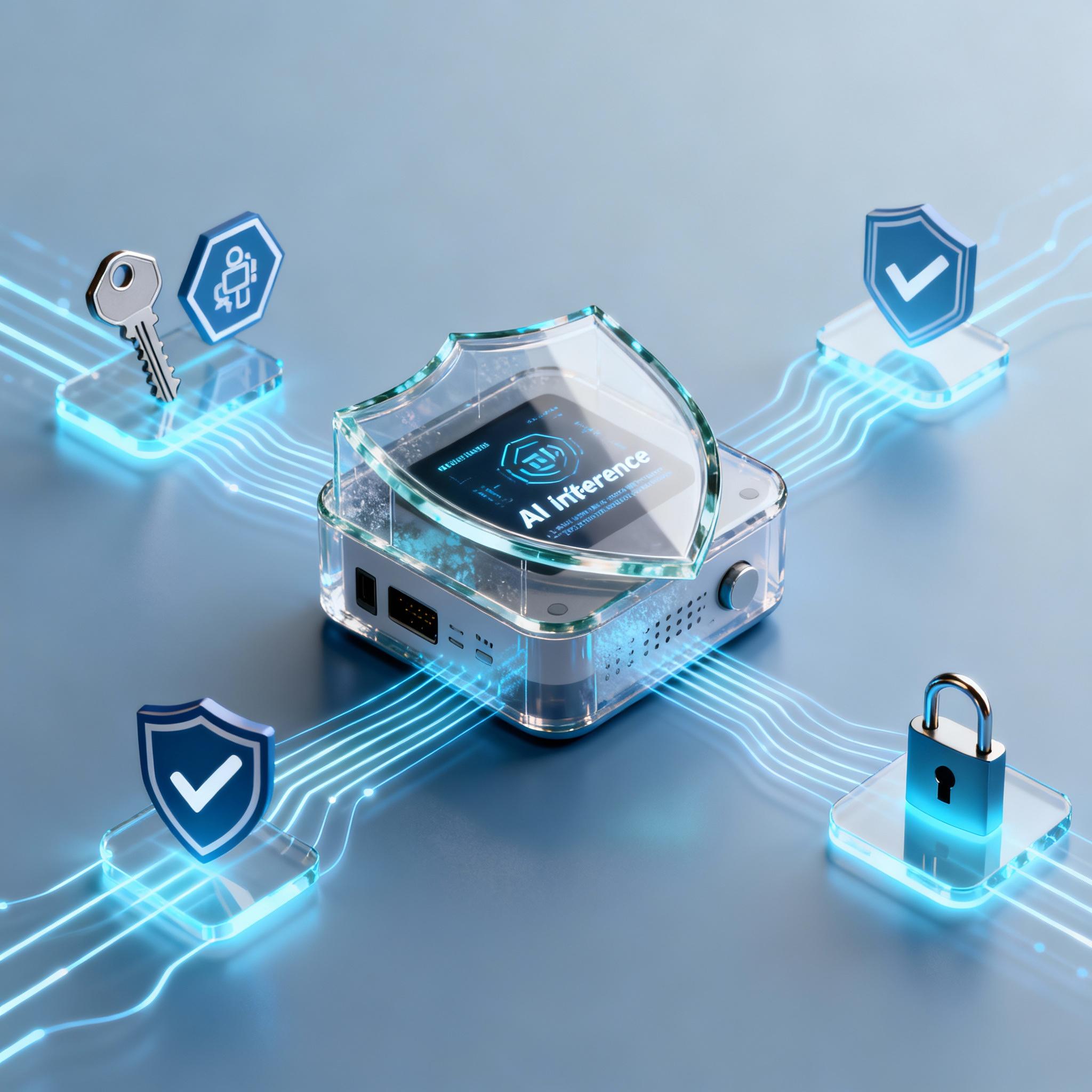
Secure On-Device AI: Privacy-Preserving Edge Inference for IoT in 2025, with Defenses Against Model Theft and Data Exfiltration
Practical guide to securing on-device AI for IoT in 2025: hardware roots, attestation, DP, watermarking, and defenses vs. model theft and data exfiltration.
Secure On-Device AI: Privacy-Preserving Edge Inference for IoT in 2025, with Defenses Against Model Theft and Data Exfiltration
Privacy-preserving, efficient on-device inference is now mainstream in IoT. The challenge in 2025 is less about running models offline and more about defending those models and sensitive data from theft or covert exfiltration. This post gives engineers a compact, practical blueprint: the threat model, concrete defenses (hardware and software), a code-level example for attestation and sealed model loading, and a deployment checklist you can use today.
Why secure on-device AI matters now
IoT devices host models that represent months or years of IP and training data. They also process sensitive inputs — personal health signals, location, home video frames. When models run on-device the attack surface moves from a remote API to many physical endpoints. Attackers aim for two wins:
- Model theft: extracting weights or reconstructing models to rehost or steal IP.
- Data exfiltration: coaxing a device to leak inputs, intermediate representations, or aggregated sensitive data.
You must design for both. A device that computes locally but returns unrestricted outputs is still a data leak. A model stored unprotected on flash is a headline waiting to happen.
Practical threat model
Actors
- Local attacker with physical access (chip-off, JTAG, debug UART).
- Remote attacker who controls network inputs and can query models or push OTA updates.
- Insider/rogue firmware: compromised supply chain or malicious update server.
- Side-channel attackers using power, timing, or electromagnetic analysis.
Capabilities and goals
- Read or copy model files from flash.
- Interact with inference API to probe for secrets via crafted inputs.
- Install a backdoor or exfiltration channel in firmware.
Design decisions should assume the strongest realistic capability you’ll face in the field and prioritize controls that raise the cost of successful attack beyond the adversary’s return on investment.
Core building blocks for secure on-device inference
These are actionable controls you can combine for defense-in-depth.
1) Hardware root of trust and secure boot
Secure boot with a hardware root of trust ensures only signed firmware runs. Pair secure boot with firmware rollback protection (monotonic counters). Use vendor TEE features: ARM TrustZone, Intel TDX/SGX-like environments, or vendor Secure Enclave solutions.
2) Encrypted model storage and hardware-backed keys
Store model files encrypted at rest. Use the platform keystore so keys are non-exportable and bound to hardware state (attestation key). On first provisioning, seal model keys so they unwrap only after attestation.
3) Remote attestation before unlocking assets
Only unlock model decryption keys after successful attestation. Cloud service or enterprise backend should validate device measurements (hashes of firmware, secure boot state) and issue short-lived session keys.
4) Runtime integrity and minimal trusted computing base (TCB)
Keep the TCB small: a tiny runtime in the TEE handles decryption and inference. Reduce dependencies and disable general-purpose scripting in the TEE.
5) Limit model exposure: quantize, prune, and split
Smaller models are both faster and harder to extract whole. Consider split inference where early layers run in TEE and later layers on normal world but with restricted outputs.
6) Output controls and query defenses
Treat the on-device inference interface like an API. Apply:
- Rate limiting and quotas.
- Output clipping and noise (local DP) for sensitive aggregates.
- Deny raw intermediate tensor dumps to non-privileged processes.
7) Differential privacy and local noise
Local differential privacy (LDP) can add noise before any data is logged or transmitted. LDP reduces risk of reconstructing inputs from outputs but requires calibration to preserve utility.
8) Model watermarking and fingerprinting
Embed a watermark in the model weights or use behavioral triggers — unique inputs that produce a specific signature — to prove theft. Watermarks can be deterministic patterns in seldom-used neurons or crafted trigger-set behavior.
9) Monitoring and anomaly detection
On-device monitors should watch for anomalous network activity, sudden CPU/GPU usage consistent with model exfiltration attempts, and unexpected storage writes.
Example: Attestation + sealed model load (pseudo-Python)
Below is a minimal illustration for an attestation flow. In production, use your platform SDK (TEE vendor libraries) and TLS, and never roll your own crypto.
# Device boots with secure boot and has a hardware attestation key
def request_attestation_challenge(server_url, device_id):
    # Send device ID and firmware measurement to attestation server
    measurement = read_firmware_measurement()  # hash of boot chain
    return http_post(server_url + '/attest/challenge', { 'device_id': device_id, 'measurement': measurement })

def handle_attestation_response(response):
    # response contains challenge; sign with hardware key
    signature = hw_sign(response['challenge'])
    return signature

# Server verifies signature and returns a session key encrypted to device key
# Device receives encrypted_session_key, unwraps with hw key and uses to decrypt model

def unwrap_and_load_model(encrypted_session_key, encrypted_model_blob):
    session_key = hw_unwrap_key(encrypted_session_key)
    model_bytes = symmetric_decrypt(session_key, encrypted_model_blob)
    load_model_into_tee(model_bytes)
This flow ensures the server only issues model decryption keys to devices presenting expected firmware/measurement.
Code snippet: local DP before logging
# Add Laplacian noise to a scalar measurement x
def laplace_noise(x, scale):
    import random, math
    u = random.random() - 0.5
    return x - scale * math.copysign(math.log(1 - 2 * abs(u)), u)

def log_private(value, epsilon):
    # sensitivity assumed 1 for normalized inputs
    scale = 1.0 / epsilon
    noisy = laplace_noise(value, scale)
    secure_log(noisy)
Tune epsilon for the privacy-utility tradeoff and consider clipping values before noise addition.
Defenses specific to model theft and exfiltration
- Model encryption + attestation: prevents direct file copy from being useful.
- Non-exportable hardware keys: prevent keys from being retrieved through software.
- Watermark triggers: enable legal or technical detection of stolen models.
- Output sanitization: refuse to return raw embeddings or high-dimensional vectors unless authorized.
- Query behavior analytics: flag sequences of queries designed to invert models.
- Tamper detection & zeroization: if debug ports or tamper switches are opened, zero secrets immediately.
Also consider deployment-level controls: stagger model rollouts, monitor clones appearing in third-party repos, and use watermarking to legally pursue theft.
Performance and privacy tradeoffs
- TEEs add overhead — measure inference latency inside TEE vs. normal world. Use quantized models to offset cost.
- DP noise reduces accuracy; prefer smaller epsilon for highly sensitive data and larger for telemetry.
- Split inference shifts attack surface; choose which layers to protect based on model architecture and value of representations.
Checklist for production deployments
- Hardware root of trust enabled and tested.
- Secure boot and rollback protection in place.
- Models encrypted at rest and bound to hardware keys.
- Remote attestation flow implemented; server-side policy verifies measurements.
- Small TCB: inference in TEE or a verified runtime.
- Output policies: rate limiting, clipping, LDP where needed.
- Watermarking/fingerprinting in model artifacts.
- Logging and anomaly detection for noisy exfil traces.
- OTA pipeline with signed updates and staged rollouts.
- Tamper detection and secrets zeroization on compromise.
Summary
Securing on-device AI is a systems problem: combine hardware roots, attestation, encrypted storage, runtime integrity, output controls, and privacy-preserving techniques. The goal is to make model theft expensive and data exfiltration unlikely and detectable. Implement remote attestation to gate key release, add local DP to protect sensitive outputs, fingerprint models to track misuse, and monitor device behavior for suspicious patterns.
Quick checklist (copy-paste):
- Secure boot & hardware root of trust
- Encrypted models + hardware-keystore-bound keys
- Remote attestation before key release
- Run critical code in TEE / minimal TCB
- Output controls: rate limits, clipping, LDP
- Model watermarking / behavioral fingerprints
- Tamper detection + zeroization
- Anomaly detection for network/storage patterns
Start with attestation and encrypted model storage — they give the biggest reduction in risk per engineering hour. Layer the rest for defence-in-depth and tune DP and output policies to your app’s tolerance for accuracy loss.