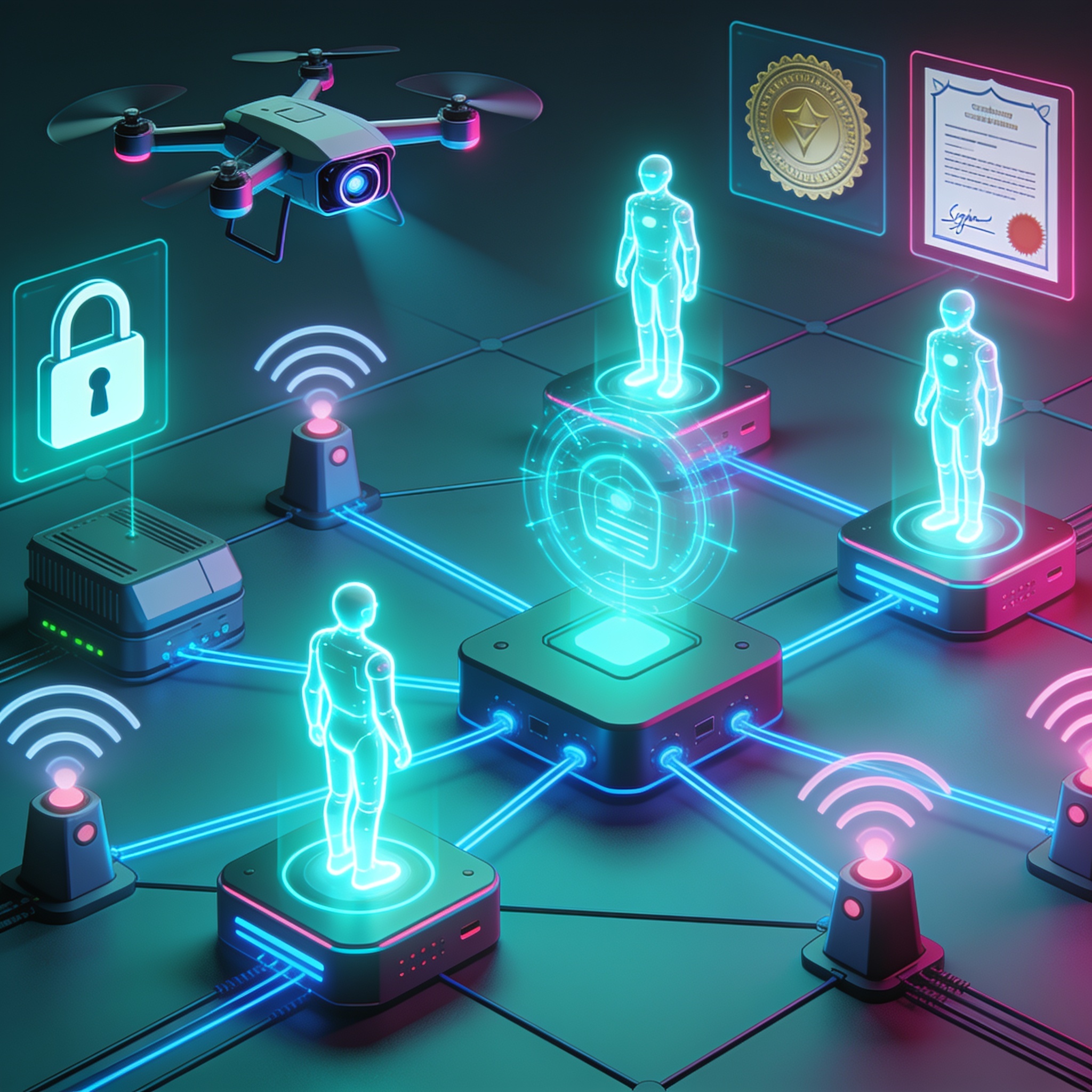
Securing Decentralized Agentic Workflows: Challenges in Multi-Agent Edge AI Architectures
Practical guidance for securing multi-agent edge AI: threat model, attack surfaces, design principles, and concrete controls for decentralized agentic workflows.
Securing Decentralized Agentic Workflows: Challenges in Multi-Agent Edge AI Architectures
Edge AI is moving from isolated models to decentralized, agentic workflows: fleets of lightweight agents collaborate, negotiate, and act across heterogeneous devices. This introduces new complexity — not only in orchestration and latency, but in security. This post sketches a practical threat model, enumerates attack surfaces unique to multi-agent edge setups, and outlines concrete, implementable controls and patterns developers can apply today.
Why agentic workflows change the security game
Traditional cloud-first ML systems rely on a central control plane and perimeter defenses. Agentic workflows replace that single control plane with distributed decision-making: agents spin up, exchange capabilities, form coalitions, and execute tasks locally. That distribution yields resilience and efficiency but also:
- Expands the attack surface (many more nodes, diverse environments).
- Breaks assumptions about centralized policy enforcement.
- Requires secure delegation: agents must safely give other agents authority to act.
- Increases the risk of model and data poisoning, lateral movement, and stealthy exfiltration.
A realistic security posture for agentic edge systems must be built around explicit threat modeling, strong identity and attestation, least-privilege capability delegation, and verifiable provenance.
Threat model: what to assume
Make these assumptions explicit before designing controls:
- Adversary goals: compromise model integrity, extract sensitive data, co-opt agent behaviors, or disrupt workflows.
- Adversary capabilities: local access to some edge nodes, ability to intercept local network traffic, supply-chain compromise potential, and limited ability to create new agent identities.
- Trust boundaries: device hardware, local OS, container runtimes, remote management services, and cloud registries.
Design to minimize blast radius when any single node or agent is compromised, and assume some components are hostile.
Core attack surfaces in multi-agent edge AI
1. Identity and impersonation
Agents communicate, exchange capabilities, and accept tasks. If an attacker can impersonate an agent (or spin up a fake agent), they can inject malicious tasks or exfiltrate data.
2. Model and data poisoning
Agents may share learned updates, prompts, or small model artifacts. Untrusted contributions can corrupt behaviors or leak training data.
3. Lateral movement and privilege escalation
Shared local networks, developer tooling, and over-privileged runtimes enable attackers to move between agents and escalate privileges.
4. Supply chain and provisioning risks
Compromised images, libraries, or model weights distributed to edge devices infect the fleet.
5. Covert channels and exfiltration
Agents with legitimate comms may hide data in protocol fields or use third-party services to exfiltrate.
Design principles for secure agentic workflows
These high-level principles guide concrete choices:
- Zero trust: never implicitly trust another agent or node; always authenticate and authorize.
- Least privilege: grant capabilities narrowly, with expiration and scoping.
- Strong attestation: verify device and runtime integrity before trusting an agent.
- Immutable provenance: sign artifacts and record lineage for models, prompts, and task results.
- Observability and defense-in-depth: telemetry, anomaly detection, and runtime containment.
Practical controls and patterns
Below are controls engineers can implement with current tooling. They are pragmatic and composable.
Mutual identity and attestation
- Use hardware-backed identities where available (TPM, secure element). Each device or agent should have a unique asymmetric key pair provisioned securely.
- Implement remote attestation: before accepting tasks or capabilities from a peer, request an attestation quote that includes measurements of firmware, kernel, and runtime.
- Short-lived agent credentials: rotate keys and use short-lived certificates rather than long-lived tokens.
Capability-based authorization
- Model permissions as capabilities (opaque tokens granting narrowly-scoped actions) rather than broad roles. Capabilities should include resource scope, allowed operations, and expiry.
- Use cryptographically bound capability tokens that require signature verification before execution.
Signed provenance and immutable logs
- Sign models, sub-models, and prompt templates using the owner’s signing key. Consumers should verify signatures and check the provenance chain.
- Record task, message, and state changes in append-only logs. Where possible, use tamper-evident logs (Merkle trees) and periodically anchor checkpoints to a remote immutable store.
Secure communications
- Always use authenticated encryption (mTLS or equivalent) between agents. Mutual TLS with device certs ties identity to a key.
- For intermittent connectivity, use secure message queues with server-side validation and replay protection.
Runtime containment and least privilege
- Run agents in minimal runtime sandboxes (distinct OS users, containers with minimal capabilities, seccomp filters).
- Limit filesystem and device access. If an agent needs sensor data, provide a narrow API rather than raw device file access.
Behavior validation and anomaly detection
- Use lightweight behavioral models to validate agent outputs before acting (sanity checks, thresholding, allow-lists).
- Centralize anomaly telemetry: even in decentralized workflows, stream metadata (not raw data) to analytics to detect compromised agents.
Key management and PKI at the edge
Edge environments make central PKI difficult. Mix solutions:
- Hierarchical PKI for fleet-wide trust: a fleet CA issues device certs during provisioning, but certs are short-lived and must be refreshable offline.
- On-device key protection: store private keys in TPM or secure element. On devices without hardware roots, use kernel keyrings and process-level protections.
- Certificate enrollment: implement automated enrollment (SCEP, EST) with device identity proofs and attestation during bootstrap.
Pattern: capability exchange and verification (example)
Below is a compact example of an agent verifying a capability token before executing a delegated action. The snippet demonstrates the verification flow — keep tokens short-lived, include a nonce, scope, and an issuer signature.
# Agent receives a capability token from peer_agent
token = receive_token()  # opaque, signed structure
capability_payload, signature = parse_token(token)

# Verify signature against issuer public key (fetched from trusted registry or pinned)
if not verify_signature(issuer_pubkey, capability_payload, signature):
    reject("invalid signature")

# Validate scope and expiry
if capability_payload.expires_at < now():
    reject("expired")
if not allowed_scope(capability_payload.scope, requested_action):
    reject("scope mismatch")

# Verify nonce / replay protection
if nonce_seen_before(capability_payload.nonce):
    reject("possible replay")

# Execute action in a restricted sandbox
result = execute_in_sandbox(requested_action, sandbox_profile_for(capability_payload))
send_result_back(result)
Notes:
verify_signatureshould use well-known libs and constant-time checks.execute_in_sandboxmust enforce minimal I/O and no network access unless explicitly granted.
Handling model and data poisoning
- Protect training inputs and small-weight updates with provenance and signature checks. Don’t accept model deltas from untrusted sources without validation.
- Use differential validation: cross-check model updates on a small holdout set on multiple independent nodes before promoting them.
- Rate-limit and sanity-check behavioral changes. Sudden, high-impact drift is suspicious.
Recovery and containment
- Design for rapid containment: automated revocation of device certs, fleet quarantine, and rolling key rotation.
- Maintain a “kill-switch” capability: an authenticated, auditable path to force agents into a safe mode where they accept no new delegation and only respond to authenticated queries.
Operational practices
- Supply-chain hygiene: sign images and model artifacts. Deploy reproducible builds and scan artifacts for known vulnerabilities.
- Threat hunting: collect structured telemetry (task metadata, capability grants, attestation records) and run regular correlation to detect compromised agents.
- Incident playbooks: rehearse revocation, re-provisioning, and model rollback scenarios.
> Security is not a single control; in decentralized agentic systems, it’s an architecture of mitigations: identity, attestation, provenance, containment, and observability.
Summary and checklist
- Identity and attestation
- Provision hardware-backed keys where possible
- Require remote attestation before trust
- Authorization
- Use capability-based tokens, short-lived and scoped
- Validate signatures, nonces, and expiry for every delegation
- Provenance
- Sign models, prompts, and artifacts
- Maintain tamper-evident logs and checkpoints
- Communications and runtime
- Use mTLS and authenticated encryption
- Sandboxed runtimes, minimal privileges, resource caps
- Detection and recovery
- Centralize telemetry for anomaly detection
- Prepare automated revocation and quarantine flows
Implementing secure agentic workflows is work: it touches provisioning, cryptography, runtime, and operational processes. Start with strong device identity and attestation, build capability-based authorization, and make provenance and observability first-class — those three pillars will let you scale agentic edge architectures without giving attackers an easy path to compromise the entire system.