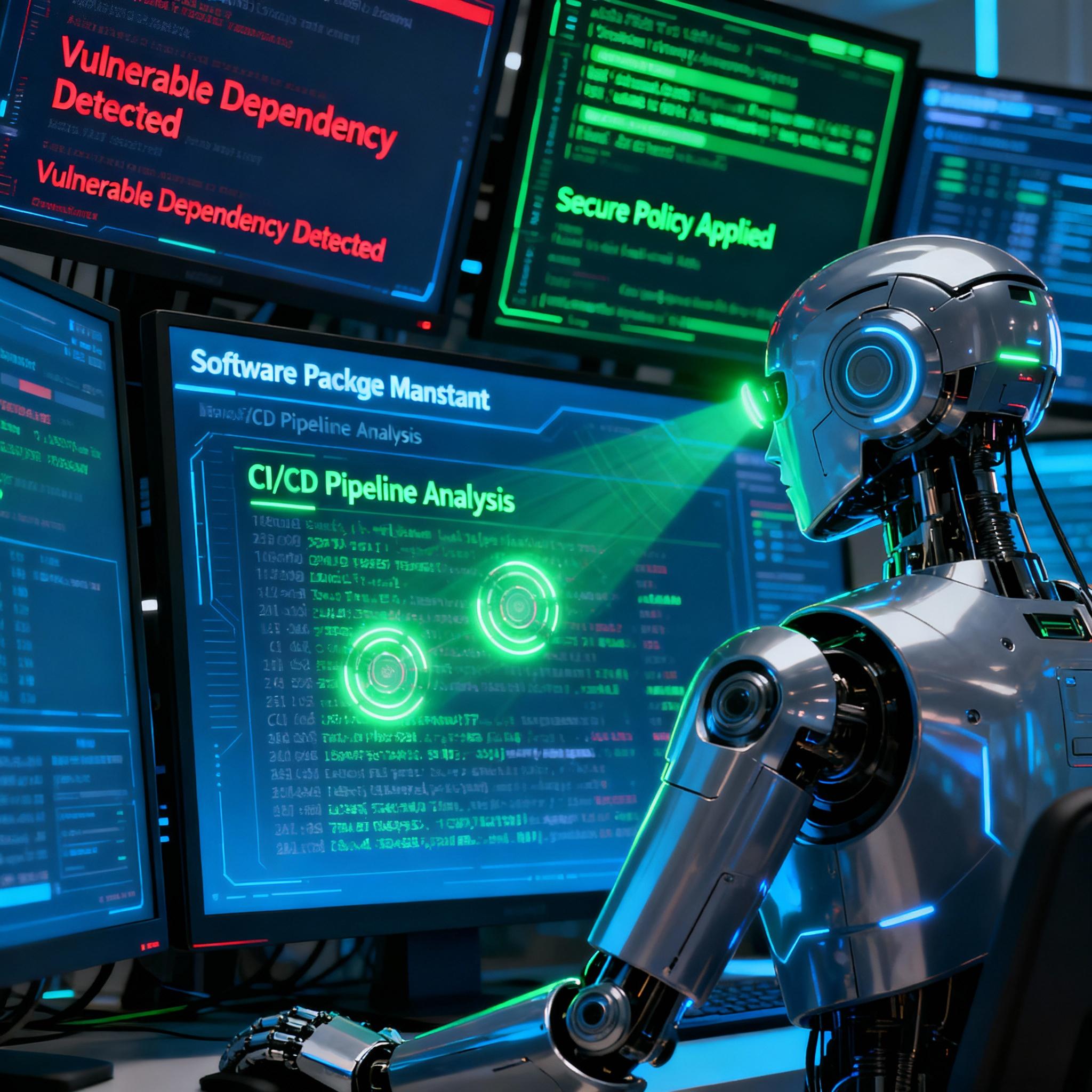
Security-aware AI copilots: enable autonomous dependency audits and secure-by-default CI/CD
How to integrate security-aware AI copilots that autonomously audit dependencies and enforce secure-by-default policies in CI/CD pipelines.
Security-aware AI copilots: enable autonomous dependency audits and secure-by-default CI/CD
Security teams and developers are drowning in alerts: vulnerable transitive dependencies, misconfigured CI jobs, and pipeline permissions that grant excessive power to build agents. Foundation models provide a practical vector to make CI/CD smarter — not by replacing humans but by autonomously performing routine, high-value security work. This article shows how to design, implement, and operate security-aware AI copilots that audit dependencies, reason about risk, and enforce secure-by-default policies in CI/CD pipelines.
Why an AI copilot for supply-chain security?
- Developers ship code more frequently than ever; human review is a bottleneck.
- Existing scanners produce noisy findings and require expert triage.
- Foundation models can synthesize context across SBOMs, advisories, and pipeline configs to produce prioritized, automated decisions.
An AI copilot can: detect exploitability across transitive dependencies, recommend minimal remediations, open prioritized tickets, and gate deployments when a risk exceeds policy. The goal: reduce time-to-detect, increase mean-time-to-remediate, and enforce secure-by-default behavior consistently across teams.
Core design principles
Principle 1 — Determinism and auditable decisions
Copilots must produce reproducible, auditable outputs. Every decision needs a provenance chain: the SBOM or lockfile, the advisory database snapshot, the policy version, and the model prompt that produced the decision.
Principle 2 — Least privilege and safe actions
The copilot should default to recommending human approval before executing destructive fixes. Automated actions should be scoped, reversible, and logged. Prefer create-findings and block-deploy over auto-patch unless a policy explicitly allows automatic remediation.
Principle 3 — Policy-as-code and versioning
Encode security expectations as versioned policy artifacts. The copilot evaluates dependencies against policy, not ad-hoc heuristics. Policy can express thresholds like CVSS > 7.0, unsupported vendor, or absence of signed packages.
Architecture overview
At a high level, a security-aware AI copilot sits between three inputs and outputs:
- Inputs: SBOM/lockfiles, CI/CD pipeline manifests, vulnerability advisories (OS and language ecosystems), runtime context (environment, secrets exposure).
- Core: a model-driven decision engine that runs rules, queries advisories, and synthesizes remediation plans. It uses deterministic prompts, chained tooling, and a retrieval layer for up-to-date facts.
- Outputs: inline CI annotations, policy decisions (allow/block), triaged tickets, and optional automated fixes.
Key components:
- SBOM extractor (build-time): emits normalized dependency graph and metadata.
- Vulnerability retrieval: caches advisories from NVD, ecosystem feeds, and vendor notices.
- Decision engine: foundation model + deterministic reasoning layer + human review path.
- CI/CD plugin: enforces decisions (fail builds, add comments, open PRs).
- Audit log: immutable record linking inputs to outputs.
Practical implementation pattern
Below is a pragmatic pattern you can implement in an existing CI system (GitHub Actions / GitLab CI / Jenkins):
- Generate SBOM during the build using your package manager or
syft. - Run a fast, deterministic scanner (OSV, internal DB) to capture high-confidence vulnerabilities.
- Pass the SBOM and scanner results to the AI copilot microservice for contextual triage.
- The copilot returns:
decision,explanation,recommended_action,evidence_refs. - CI enforces the decision per policy configuration.
Example decision payload (inline JSON example)
Use inline JSON with escaped braces to show the decision shape:
{ "decision": "block", "reason": "transitive dependency reachable in runtime", "policy_version": "2025-04-01" }
Minimal Python prototype (CI hook)
The following shows a minimal prototype for a CI job that calls a local copilot API, evaluates its response, and fails the build when the copilot requests a block. This is a full, runnable snippet concept — adapt to your environment.
import json
import os
import requests

COPILOT_URL = os.getenv('COPILOT_URL', 'http://localhost:8080/evaluate')
SBOM_PATH = os.getenv('SBOM_PATH', 'sbom.json')
POLICY = 'v1.2'

with open(SBOM_PATH, 'r') as f:
    sbom = json.load(f)

payload = {"sbom": sbom, "policy": POLICY, "context": {"ci_job": os.getenv('CI_JOB_NAME')}}
resp = requests.post(COPILOT_URL, json=payload, timeout=30)
resp.raise_for_status()
decision = resp.json()

print('Copilot decision:', decision.get('decision'))
if decision.get('decision') == 'block':
    print('Blocking deployment. Evidence:')
    for e in decision.get('evidence', []):
        print('-', e)
    raise SystemExit(1)

print('Proceeding with CI job.')
Notes:
- The microservice must sign responses so CI can verify authenticity.
- The copilot must return
evidencewith advisory IDs and paths into the SBOM so triage is trivial.
Prompting and the deterministic layer
Foundation models are powerful but not inherently deterministic. Wrap the model with a deterministic reasoning layer:
- Use retrieval-augmented generation (RAG) to inject precise advisory text and SBOM fragments.
- Keep prompts minimal and structured: avoid long open-ended instructions.
- Run a post-processing rules engine that validates the model’s claims against the source data (e.g., check that claimed vulnerable versions exist in the SBOM).
Example of a strict prompt structure (conceptual):
- System: You are a security copilot. Always return JSON with keys
decision,confidence,evidence. - User: Here is SBOM entry X and advisory Y. Is the vulnerability reachable in runtime? Answer with
blockorallowand list evidence.
Enforce the model to use only provided evidence by letting the deterministic layer fail predictions that reference outside facts.
Policy examples and enforcement modes
Policies should express both hard denies and soft recommendations:
- Hard deny: CVSS > 9.0 combined with reachable runtime usage →
block. - Soft deny: CVSS 7.0–9.0 → create ticket, annotate PR, but do not block.
- Auto-remediate: patch minor non-breaking updates for low-risk packages with confirmed tests.
Store policies as code and version them. The copilot evaluates using a specific policy version and includes that reference in every decision.
Operational concerns
Drift, freshness, and caching
Vulnerability feeds update continuously. The copilot must timestamp the advisory snapshot it used and re-evaluate older decisions if the advisory data changes. Implement automated rechecks for blocked PRs when the advisory DB updates.
Rate limits and inference cost
Not every dependency needs a full model run. Use a tiered approach: deterministic scanners first, model triage for ambiguous or high-impact findings.
Human-in-the-loop and escalation
Build explicit escalation paths: Slack alerts, dedicated remediation queues, and on-call rotations. Provide a single-click override workflow with review logging to maintain auditability.
Example CI policy checklist
- SBOM generated for each build and attached to the build artifact.
- Deterministic scanner run before model invocation (cache results for speed).
- Copilot decision signed and stored in audit log with policy_version and advisory snapshot timestamp.
- Enforced actions: annotate PRs, open tickets, optionally block deployments.
- Re-evaluation triggered on advisory DB update or SBOM change.
Summary checklist (operational quick-reference)
- Produce SBOMs on every build.
- Run a fast deterministic vulnerability scan as a gate.
- Invoke the AI copilot only for prioritized/ambiguous findings.
- Enforce decisions via CI with signed responses and immutable audit logs.
- Version and lint policies as code; prefer conservative default actions.
- Provide human review and one-click overrides with recorded justification.
- Re-evaluate blocked artifacts when feeds change.
Security-aware AI copilots can reduce alert fatigue, speed up triage, and enforce consistent secure-by-default policies across CI/CD. The implementation challenge is not the model itself but the surrounding engineering: deterministic scaffolding, auditable decisions, and clear policy. Start small — SBOM + deterministic scan + copilot triage — then expand automation scope as trust grows.
> Practical next steps: generate your first SBOM, create a minimal deterministic scanner pipeline, and prototype a copilot endpoint that returns decision and evidence. Use the checklist above to iterate safely.