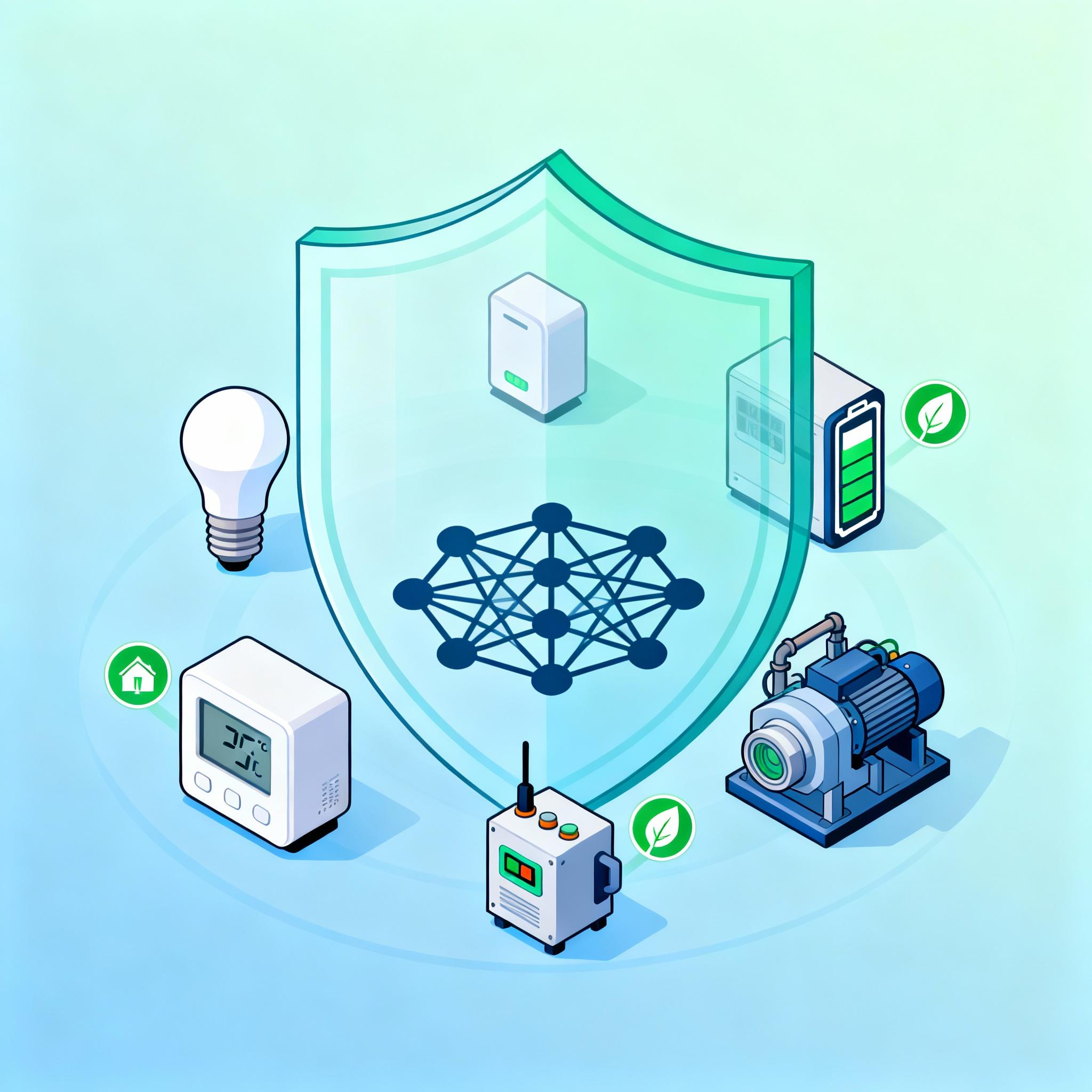
TinyML and Edge AI for IoT: On-device Inference, Privacy-preserving Learning, and Energy Efficiency
Practical strategies for TinyML and Edge AI in IoT: on-device inference, privacy-preserving learning, and energy-efficient deployments for home and industrial devices.
TinyML and Edge AI for IoT: On-device Inference, Privacy-preserving Learning, and Energy Efficiency
Introduction
Edge AI and TinyML are no longer experimental side projects — they’re how real IoT systems deliver fast responses, preserve privacy, and run on batteries for months or years. This post gives engineers a practical playbook for designing, implementing, and measuring TinyML on home and industrial devices. You’ll get concrete strategies for on-device inference, privacy-preserving learning, and energy optimizations that map directly to MCU, SoC, and gateway-class hardware.
Why TinyML and Edge AI matter
- Latency: local inference eliminates round-trip network delays and reduces jitter.
- Privacy: raw sensor data never has to leave the device, simplifying compliance and reducing attack surface.
- Reliability: devices keep operating when connectivity is poor.
- Cost & bandwidth: sending only events or model updates reduces operational expense.
But constraints are real: kilobytes to megabytes of RAM/flash, limited compute, strict power budgets. The rest of this post focuses on pragmatic ways to work within those limits.
On-device inference strategies
Design choices fall into two broad categories: model-level techniques and system-level techniques.
Model-level techniques
- Quantization: Convert weights and activations to 8-bit integers (post-training quantization) or use quantization-aware training (QAT) to preserve accuracy. QAT is the go-to when you need top accuracy with 8-bit deployment.
- Pruning and structured sparsity: Remove redundant channels/filters. Structured pruning (whole filters) is friendlier to embedded runtimes than unstructured sparsity.
- Tiny architectures: Use models designed for small compute — MobileNet-lite, MicroSpeech, simple CNNs, or tiny transformer variants for very constrained devices.
- Knowledge distillation: Train a small student model that approximates a larger teacher. Distillation often yields better compact models than naive compression.
System-level techniques
- Operator selection: Use vendor-optimized kernels (CMSIS-NN, ARC NN, NNPACK) when available; they exploit SIMD and accelerators.
- Batch size: Run single-example inference to minimize latency and memory.
- Memory planning: Pre-allocate a single scratch buffer and reuse it across layers. Measure peak arena usage and tune buffer reuse.
- Hardware acceleration: Use DSP intrinsics, NPUs, or EdgeTPU where available.
Example: workflow for a microcontroller
- Prototype with a desktop TF model.
- Quantize with either post-training methods or QAT.
- Convert to TensorFlow Lite and then to C byte array for TFLM.
- Integrate into firmware, using CMSIS-NN kernels where applicable.
Below is a minimal inference loop you can adapt for TFLM on an MCU. This is intentionally simple — treat it as the core you measure and optimize.
// Simplified TFLM-style inference loop (pseudo-C)
TfLiteTensor* input = interpreter->input(0);
// Fill the input buffer from sensor pipeline
read_sensor_samples((int8_t*)input->data.int8, input->bytes);

TfLiteStatus r = interpreter->Invoke();
if (r != kTfLiteOk) {
    // handle error
}

TfLiteTensor* output = interpreter->output(0);
int8_t top_score = output->data.int8[0];
// convert to float using scale/zero_point if needed
When you measure, capture both latency and peak RAM. On MCUs, sometimes a model that runs 2x faster but consumes 3x RAM is a non-starter.
Privacy-preserving learning for IoT
On-device learning is gaining momentum for personalization and continual adaptation. For production systems, you must balance privacy, communication cost, and model drift.
Federated learning (FL)
- Idea: devices compute local model updates and send only updates to a server for aggregation (e.g., federated averaging).
- Benefits: raw sensor traces stay local, communication payloads are smaller than raw data, and central servers never see user data.
- Practical tips:
- Use sparse updates and compression (top-k, quantized gradients) to reduce upload size.
- Schedule updates during charging or on Wi‑Fi to avoid impacting user experience.
- Implement secure aggregation to prevent the server from reconstructing individual updates.
On-device personalization
For many IoT apps, personalization on-device (fine-tuning a small head layer) is the fastest path:
- Freeze the backbone, fine-tune a small classifier or embedding layer with local data.
- Use experience replay (small buffer of examples) to avoid catastrophic forgetting.
- Keep training rounds short and infrequent to limit compute and power impact.
Differential privacy & secure aggregation
- Differential privacy adds noise to updates so individual contributions are obscured. Use it when you must provide mathematical privacy guarantees.
- Secure aggregation protocols allow the server to compute the sum of updates without seeing individual gradients. These add cryptographic complexity and can be heavy for very constrained devices; often it’s applied at gateway level instead.
Split learning and hybrid approaches
- Split learning partitions the model: the device runs early layers and a server runs deeper layers. This lowers device compute but leaks less raw data than full upload.
- Hybrid balance: do initial feature extraction on-device, upload compact embeddings for central training or analytics.
Energy efficiency and power optimization
You must design for the device’s duty cycle, not just inference energy. Optimize sensors, preprocessing, wake patterns, and the ML model together.
Measurement first
- Always measure energy with tools like a Monsoon power monitor, USB power meter, or onboard ADC sampling solution.
- Track per-inference energy, idle consumption, and energy per useful event.
Power strategies
- Duty cycle sensors and processors: keep MCUs sleeping and wake only for meaningful events.
- Event-driven sampling: run a lightweight detector (cheap algorithm or tiny model) and only trigger the heavier model on positive detections.
- Reduce sampling rate or do compressed sensing where applicable.
Model and compiler optimizations
- Quantization reduces memory traffic — often the biggest energy win.
- Operator fusion reduces memory copies and intermediate reads/writes.
- Use compiler flags and link-time optimizations. For instance, enable size optimizations (
-Os) for flash-limited devices and profile-guided optimizations for bigger SoCs. - Prefer fixed-point or INT8 arithmetic on MCUs; floating point often costs more energy.
Case: speech keyword spotting
- Use a tiny front-end (MFCC or log-mel) implemented as efficient integer kernels.
- Run a 1D-CNN or small RNN with INT8 weights, triggered at low-power cadence.
- Use an always-on comparator or analog detection circuit to wake the MCU only when a sound threshold is crossed.
Deployment patterns and lifecycle
- Over-the-air (OTA): design robust update paths for model replacement and rollback. Keep model signatures and monotonic versioning to prevent downgrade attacks.
- Monitoring: collect telemetry (latency, memory, confidence histograms) as compact statistics, not raw data.
- Canary rollout: push models to a small fraction of devices first and monitor failure modes.
Common pitfalls and how to avoid them
- Ignoring memory fragmentation: use static memory pools for inference to avoid heap churn.
- Shipping large runtime frameworks: select micro runtimes like TFLM for MCUs instead of full TF Lite or PyTorch Mobile.
- Overfitting to lab data: validate models with in-situ data; industrial environments have different noise characteristics.
Summary and checklist
The following checklist helps you translate these ideas into a production TinyML deployment:
- Prototype and measure
- Measure latency, RAM, flash, and energy on target hardware.
- Optimize model
- Apply quantization (QAT if needed), pruning, distillation.
- Optimize runtime
- Use vendor kernels, pre-allocated scratch buffers, and operator fusion.
- Preserve privacy
- Consider federated learning, secure aggregation, or on-device personalization.
- Reduce energy
- Duty cycle, event-driven pipelines, and integer arithmetic.
- Deploy safely
- OTA updates with signature verification and canary rollouts.
Final notes
TinyML and Edge AI require you to think holistically: model, sensors, scheduler, power system, and security are all parts of the same design. Start by measuring your actual device, prioritize changes that reduce memory traffic and idle power, and favor small, reliable updates for continuous improvement.
Use this guide as a checklist when moving from research to production — you will iterate, but following these steps will keep you out of the common traps that make embedded ML projects fail.