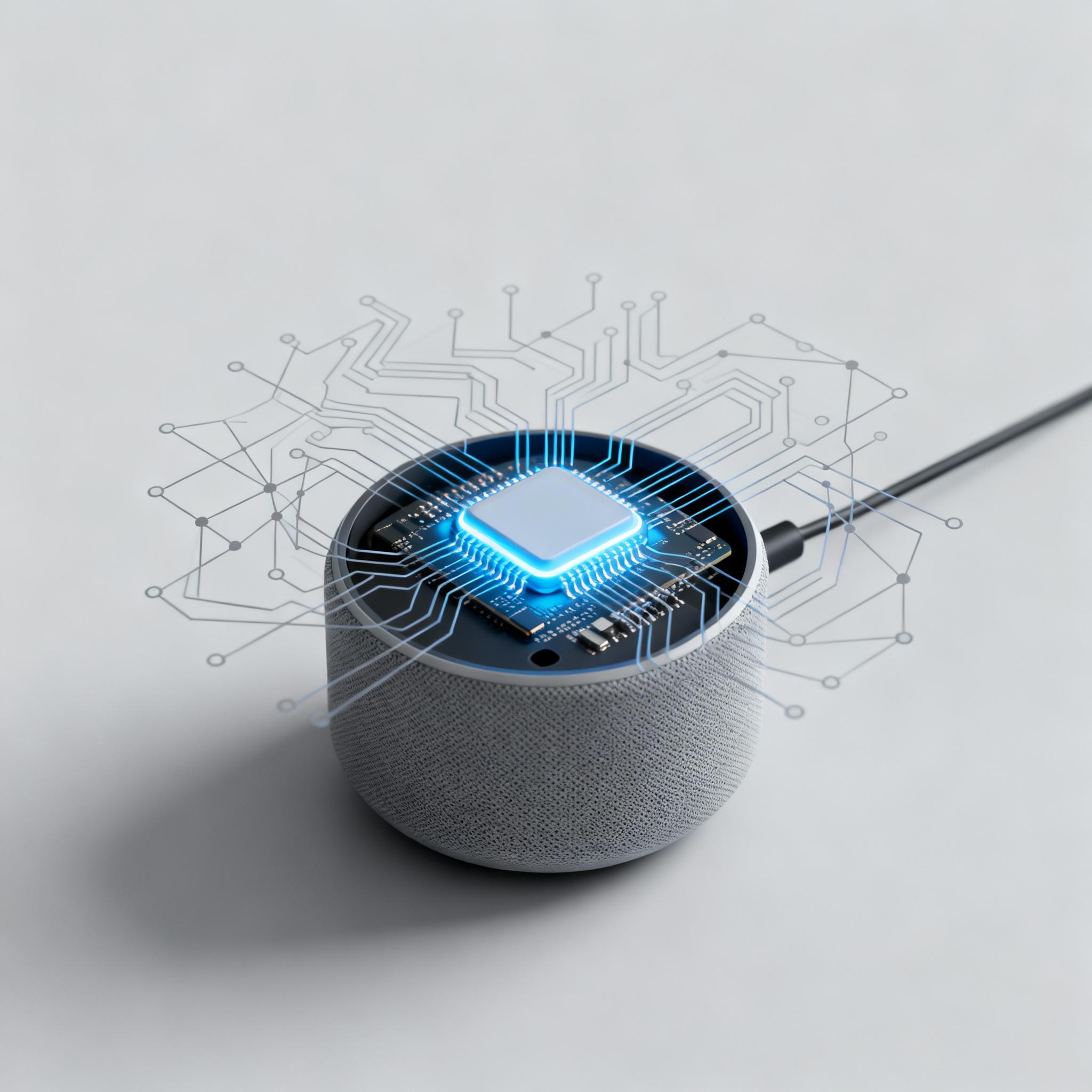
TinyML on the Edge: Privacy-preserving, Energy-efficient On-device AI for Smart Homes
Practical guide to building TinyML for smart homes — privacy-first on-device models, energy optimizations, hardware choices, and a deployment checklist.
TinyML on the Edge: Privacy-preserving, Energy-efficient On-device AI for Smart Homes
Smart home devices are moving beyond cloud-dependent features. The next generation will make decisions locally: detecting events, classifying sounds, controlling actuators, and enforcing privacy constraints — all on milliwatts of power. This post is a practical, engineer-first guide to designing TinyML systems that are both privacy-preserving and energy-efficient for constrained smart home hardware.
Why on-device TinyML matters for smart homes
- Latency: local inference avoids round-trips to the cloud, improving responsiveness for real-time tasks (wake words, intrusion detection).
- Privacy: sensor data never leaves the home when inference happens on-device — critical for audio, video, and personal activity signals.
- Reliability and cost: no dependence on network connectivity or recurring compute costs.
But you trade scale for constraints: memory in the 10s-100s KB, SRAM and flash fragmentation, limited compute, and tight energy budgets (battery-operated sensors or always-on assistants).
High-level design constraints
Resource budgets and performance targets
Start by defining hard budgets for your device:
- Memory: flash (model storage) budget and peak RAM for activation/state.
- Latency: target max inference time (e.g., <50 ms for responsiveness).
- Energy: average and peak power budgets (e.g., 10 µA standby, 1–10 mA active for battery sensors).
Design against the worst-case path where wake-word + downstream classifier run together.
Privacy and threat model
Define what you must protect:
- Raw sensor data (audio, images): avoid storing or sending off-device.
- Inference outputs: consider whether labels or embeddings transmitted to cloud reveal private info.
- Model confidentiality: if model encodes personal data, treat it as sensitive.
Mitigations include on-device-only inference, secure boot and storage, and privacy-preserving training (federated learning, differential privacy). We’ll detail these below.
Hardware building blocks and selection
Pick hardware aligned to your constraints.
- Ultra-low-power MCUs (Cortex-M0+/M3/M4): good for very small models and strict energy budgets.
- Cortex-M7/M33 with DSP: better for larger models and faster inference with CMSIS-NN.
- NPUs/ML accelerators (EdgeTPU, Kendryte, Ambiq Apollo with AI acceleration): for heavier models or when latency must be minimal.
- Always-on coprocessors: a tiny wake-word engine in a low-power domain can gate the main MCU.
Power subsystem considerations:
- DMA and peripherals that allow the CPU to sleep while collecting sensor data.
- Low-leakage retention SRAM or external FRAM for state.
- Hardware RNG and secure element for key storage.
Model architecture and optimization strategies
Design models with the device budget in mind.
- Start small: prefer compact architectures (depthwise separable convs, tiny CNNs, compact RNNs like GRU-lite).
- Cascaded models: run an ultra-low-cost detector (binary) first; trigger a larger classifier only when needed.
- Quantization: full integer quantization (8-bit) typically gives the best speed/power trade-off on MCUs. Use per-channel quantization where supported.
- Pruning and structured pruning: remove whole channels or layers to maintain efficient memory layout.
- Knowledge distillation: train a tiny student model to mimic a larger teacher to retain accuracy.
- Reduce activation memory: adopt streaming models or split models to reduce peak RAM.
Tools: TensorFlow Lite for Microcontrollers, CMSIS-NN, ONNX with custom backends, Edge Impulse for an integrated pipeline.
Energy-aware software patterns
- Duty-cycling sensors and compute: sample less frequently, increase sampling only when an event is likely.
- Event-driven pipelines: move heavy sensing to interrupts, use hardware comparators for threshold-based wake-ups.
- Model cascades to minimize average energy: cheap detector runs frequently; heavyweight classifier runs rarely.
- Batch processing: when possible, aggregate work to reduce wake cycles.
- Compiler-level optimizations: use -O3, link-time optimization, and enable CPU-specific DSP intrinsics.
Privacy-preserving techniques for on-device AI
Local-only inference
The simplest and strongest privacy measure: keep raw data and model inference on-device. Architect your system so the device emits only high-level events (e.g., motion_detected, intruder_alert) or aggregates that are less privacy-sensitive.
Secure storage and execution
- Secure boot and signed firmware to prevent tampering.
- Hardware-backed key storage or secure element for authentication and secure OTA.
- Encrypted model storage (AES-GCM) and decryption in a TEE (if available).
Federated learning and on-device personalization
To personalize models without centralizing data, use federated learning patterns where model updates — not raw data — are sent to an aggregator. In smart home contexts:
- Limit updates to parameter deltas and apply secure aggregation.
- Use client selection to avoid biased training from a single device.
- Apply differential privacy (DP) noise to updates if an attacker could reconstruct private inputs from gradients.
Note: FL and DP add communication and compute costs. Use them sparingly and batch updates.
Differential privacy and model sanitization
When model outputs are shared, add DP guarantees to prevent membership inference. For many smart home use cases, the best practice is to avoid sending sensitive outputs entirely.
Example: minimal wake-word + classifier loop (pseudo-C)
This example shows a runtime pattern: a low-cost wake-word detector runs in an always-on loop and triggers a heavier classifier. The code is illustrative for MCU firmware.
// Initialize peripherals, DMA for microphone, and model interpreter
init_audio_dma();
load_model_from_flash();
init_wake_detector();   // tiny model in fast SRAM
init_classifier();      // larger model, quantized

while (1) {
    if (audio_buffer_ready()) {
        // Run the low-cost detector (very small memory and compute)
        bool wake = run_wake_detector(audio_buffer_ptr());
        if (wake) {
            // Optionally record a short window and run a heavier classifier
            record_window();
            int label = run_classifier(recorded_window_ptr());
            log_event(label);
            // If sending telemetry, only send high-level label or encrypted summary
            if (should_send(label)) {
                send_encrypted_event(label);
            }
        }
    }
    // Enter low-power sleep until next DMA interrupt
    cpu_sleep();
}
Key patterns: DMA + interrupts to keep CPU sleeping, tiny detector to gate work, and strictly limit transmitted data.
Deployment and OTA considerations
- Signed firmware: enforce chain of trust to prevent malicious models.
- Staged rollouts: canary updates to limited devices to monitor accuracy regressions and energy impacts.
- Telemetry: collect anonymized performance metrics (latency, memory usage, power) — avoid raw sensor payloads.
- Remote configuration: allow thresholds and duty-cycle parameters to be tuned without replacing the model.
Measurement and profiling
Never guess energy. Measure it.
- Current probes and DAQ: measure active vs idle current and energy per inference.
- Cycle-accurate profilers or software timers: measure inference latency and invocation patterns.
- Memory inspectors: ensure fragmentation doesn’t spike RAM usage at runtime.
Optimize based on real measurements: a 2x latency improvement that costs 3x energy may not be acceptable in battery devices.
When cloud still makes sense
There are cases where cloud-assisted approaches are valid:
- Heavy analytics requiring global context (aggregate usage trends) — but strip or anonymize PII.
- Large multimodal models that can’t fit on-device — consider hybrid architectures where only embeddings are sent.
If you must combine cloud with edge, minimize data and apply strong encryption and access controls.
Checklist: ship TinyML the right way
- Define hard budgets: flash, RAM, latency, energy.
- Choose hardware that matches both compute and power needs (MCU vs NPU).
- Build cascaded inference to minimize average energy.
- Quantize (8-bit) and prune models; use knowledge distillation for accuracy retention.
- Implement secure boot and encrypted storage for models and keys.
- Keep raw sensor data on-device; emit only sanitized/high-level events.
- If using federated learning, apply secure aggregation and differential privacy where needed.
- Profile energy and latency on real hardware; iterate on software and model.
- Plan OTA with signed firmware and staged rollouts.
Final words
TinyML enables a new class of smart home devices: faster, more private, and cheaper to operate. The constraints force good engineering discipline: quantify budgets, optimize for energy, and bake privacy into the architecture. Start with a strict budget, measure constantly, and prefer event-driven, cascaded designs that keep the CPU asleep most of the time.
Build small, ship secure, and let the device do the thinking locally.